
Japanese Tattoos
Japanese is my favorite style of tattooing! I’ve always been drawn to Japanese culture, and the art of irezumi has always fascinated me, with its rich history, mythology, and traditions. I’ve done multiple standalone pieces, half-sleeves, 3/4 sleeves, full sleeves (both arm and leg), a few back pieces, and with several full bodysuits currently in the works. On this page, you’ll find some of my favorite Japanese tattoos I’ve done.
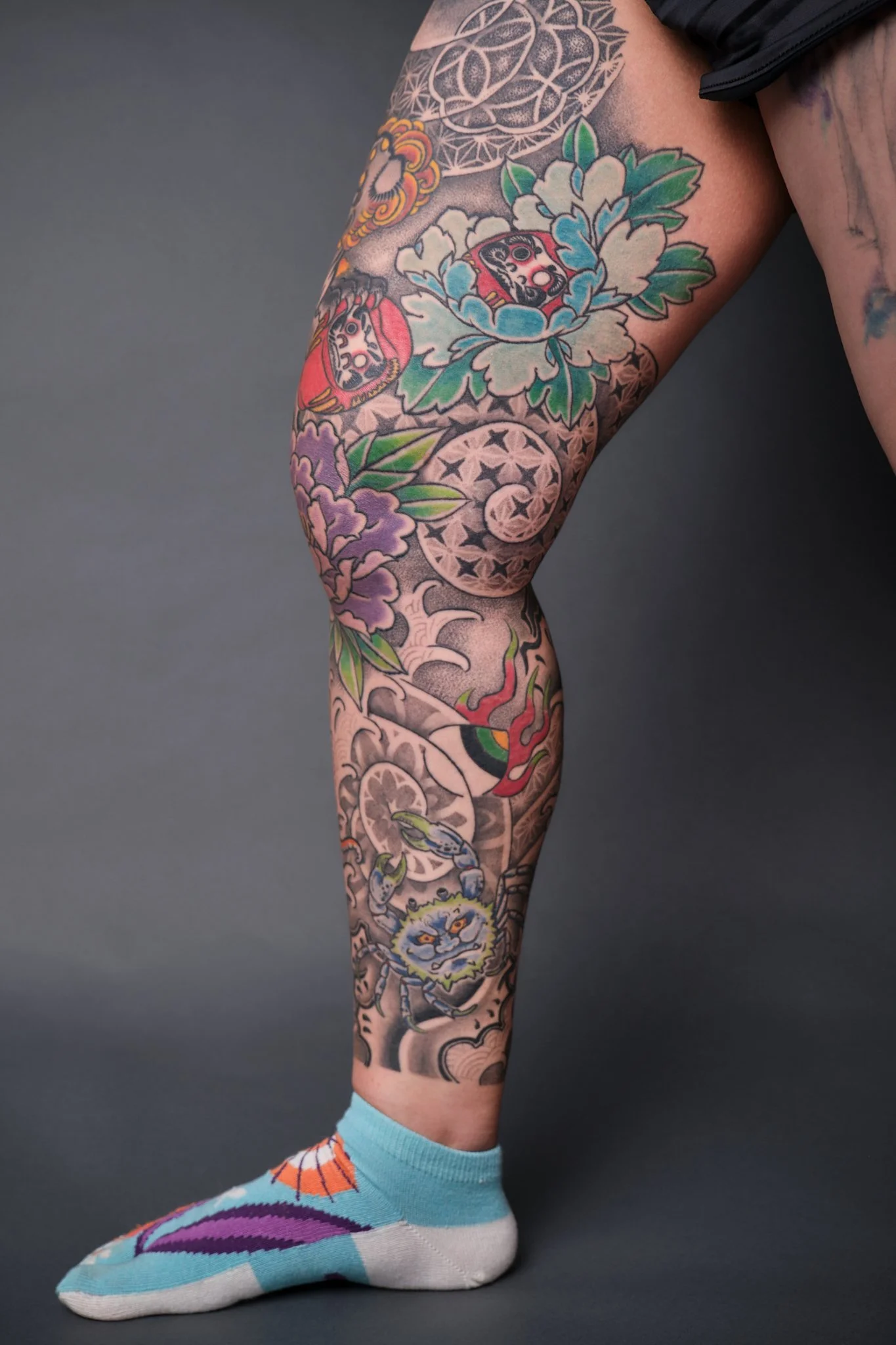
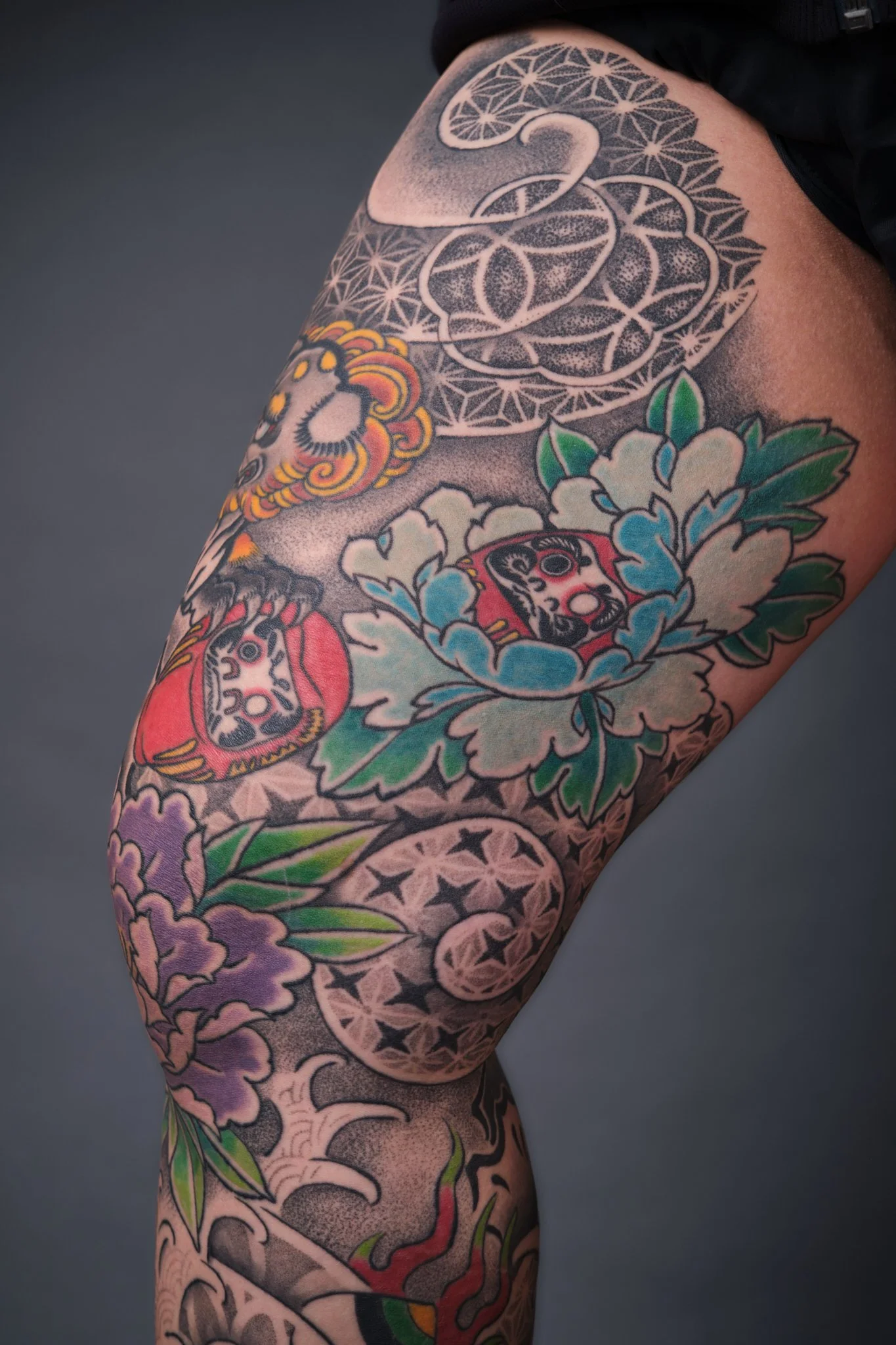



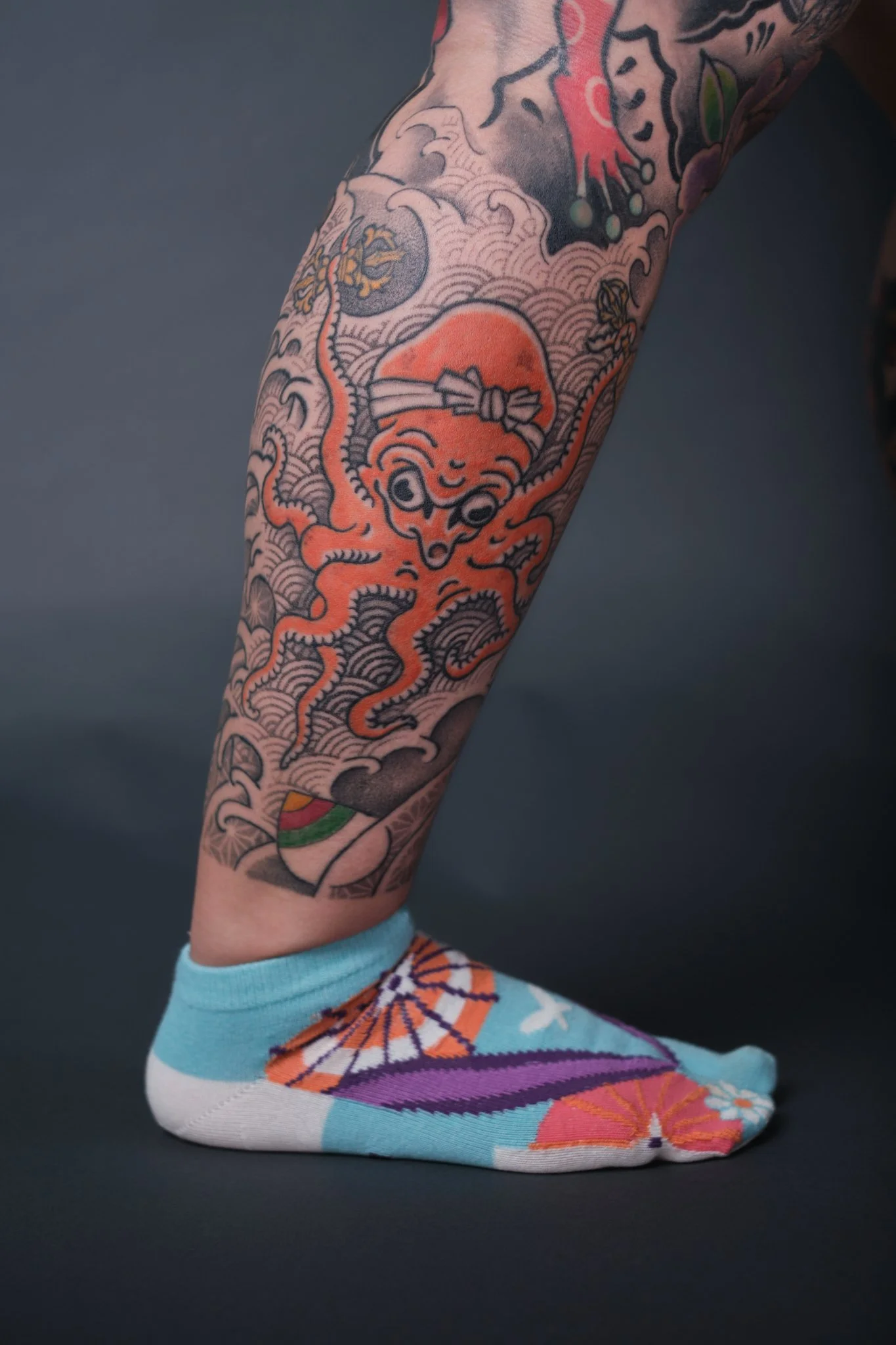
Mixed-style Japanese & stippling geometry leg sleeve
(1-year+ healed photos)


Fully healed Japanese leg sleeve from a while back! Got a mixed technique on this tattoo, blending traditional Japanese and stippling patterns in the background. There was some previous work by another artist near the top of the leg, and so we worked to integrate it and make it look like one large piece.
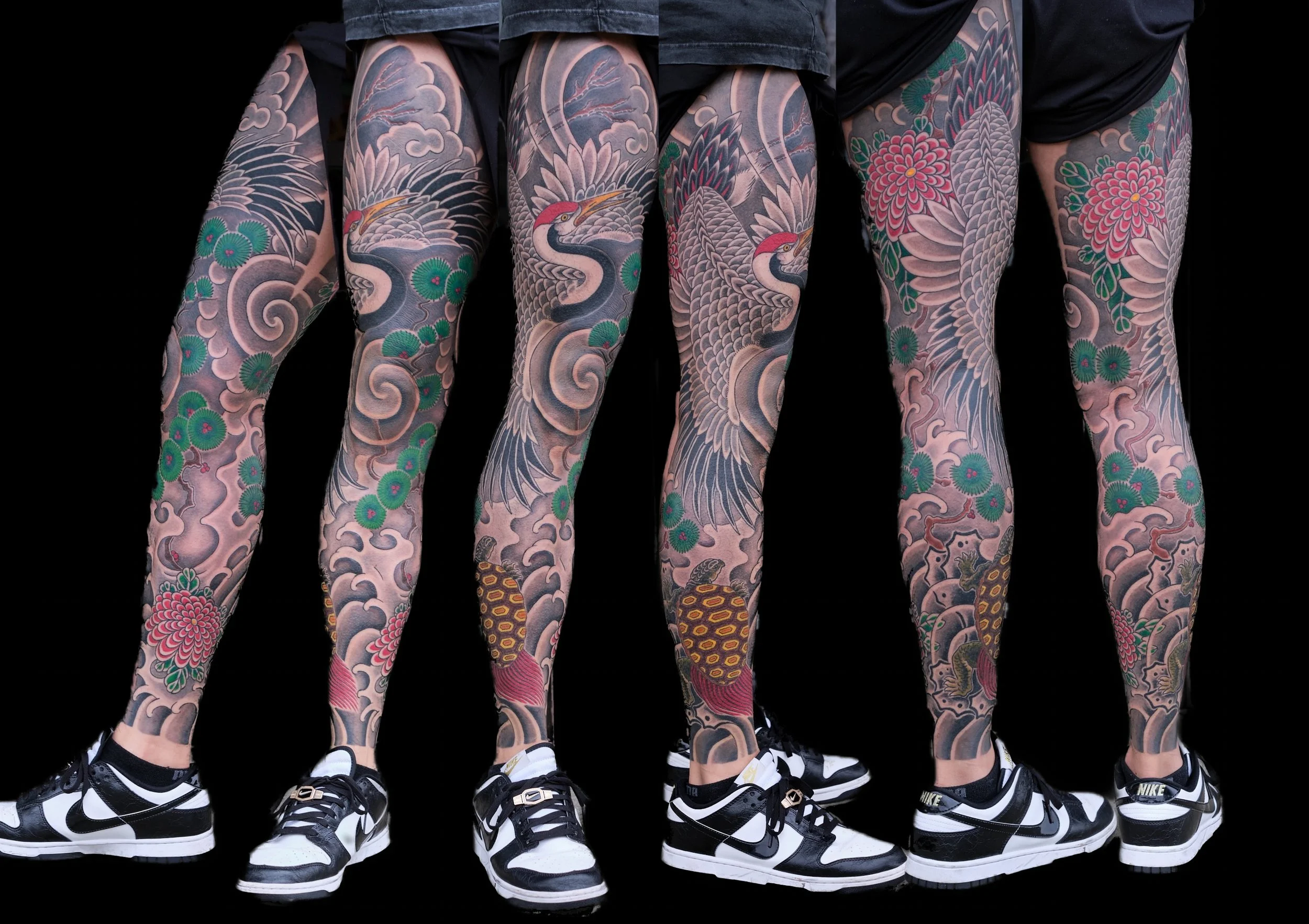
Full Japanese leg sleeve tattoo, featuring tsuru (crane), minogame (ancient turtle), and chrysanthemums
This Japanese leg sleeve blends powerful traditional symbols into one cohesive story. The tsuru (crane) represents longevity, fidelity, and good fortune, soaring gracefully through kumo (clouds) that symbolize transcendence. At the base, the minogame (ancient turtle)—its mossy tail flowing like seaweed—embodies endurance and wisdom through centuries. Scattered throughout are bold chrysanthemums, imperial flowers signifying rejuvenation and the beauty of life’s cycle. Together, these elements create a timeless tribute to resilience, grace, and enduring vitality.
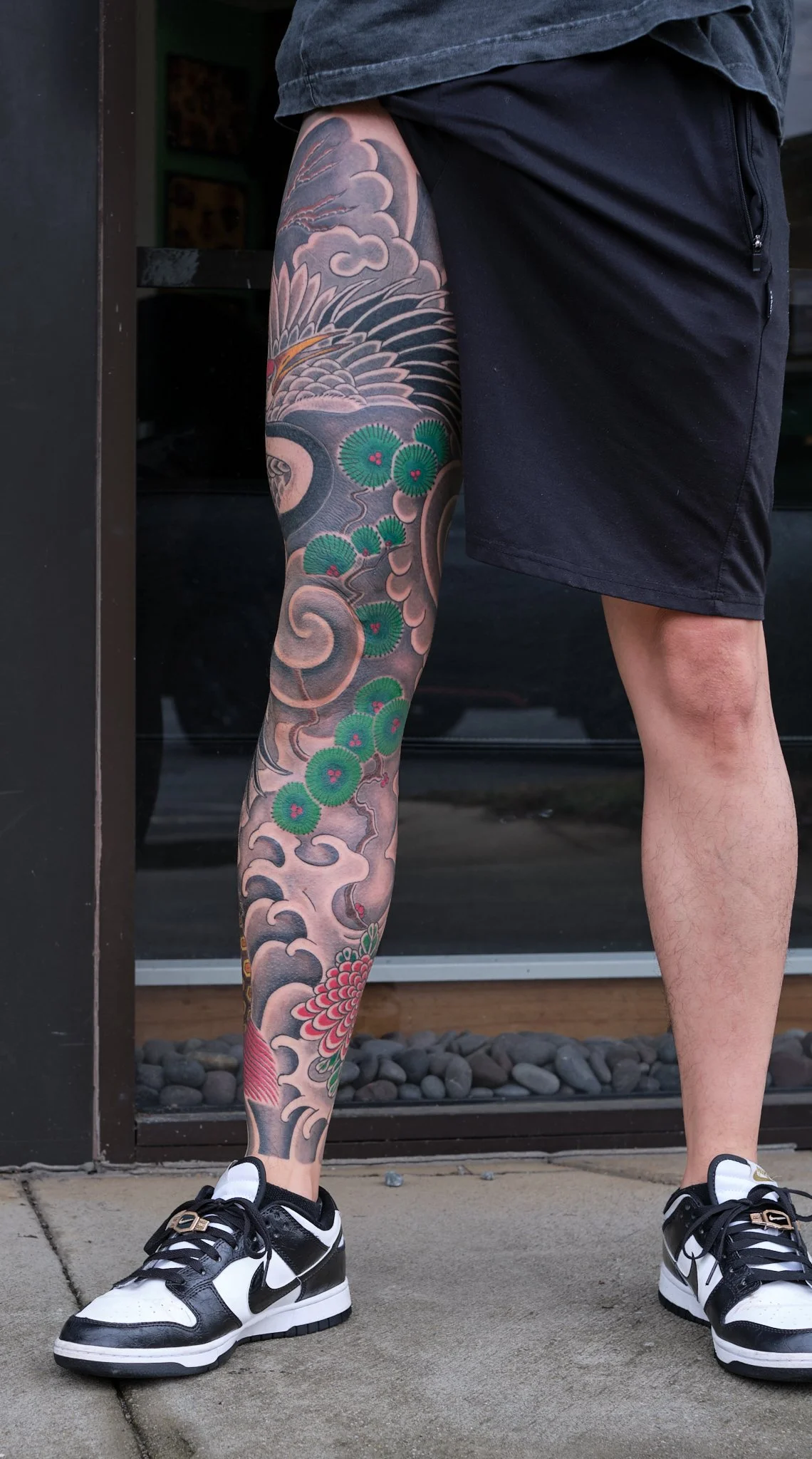
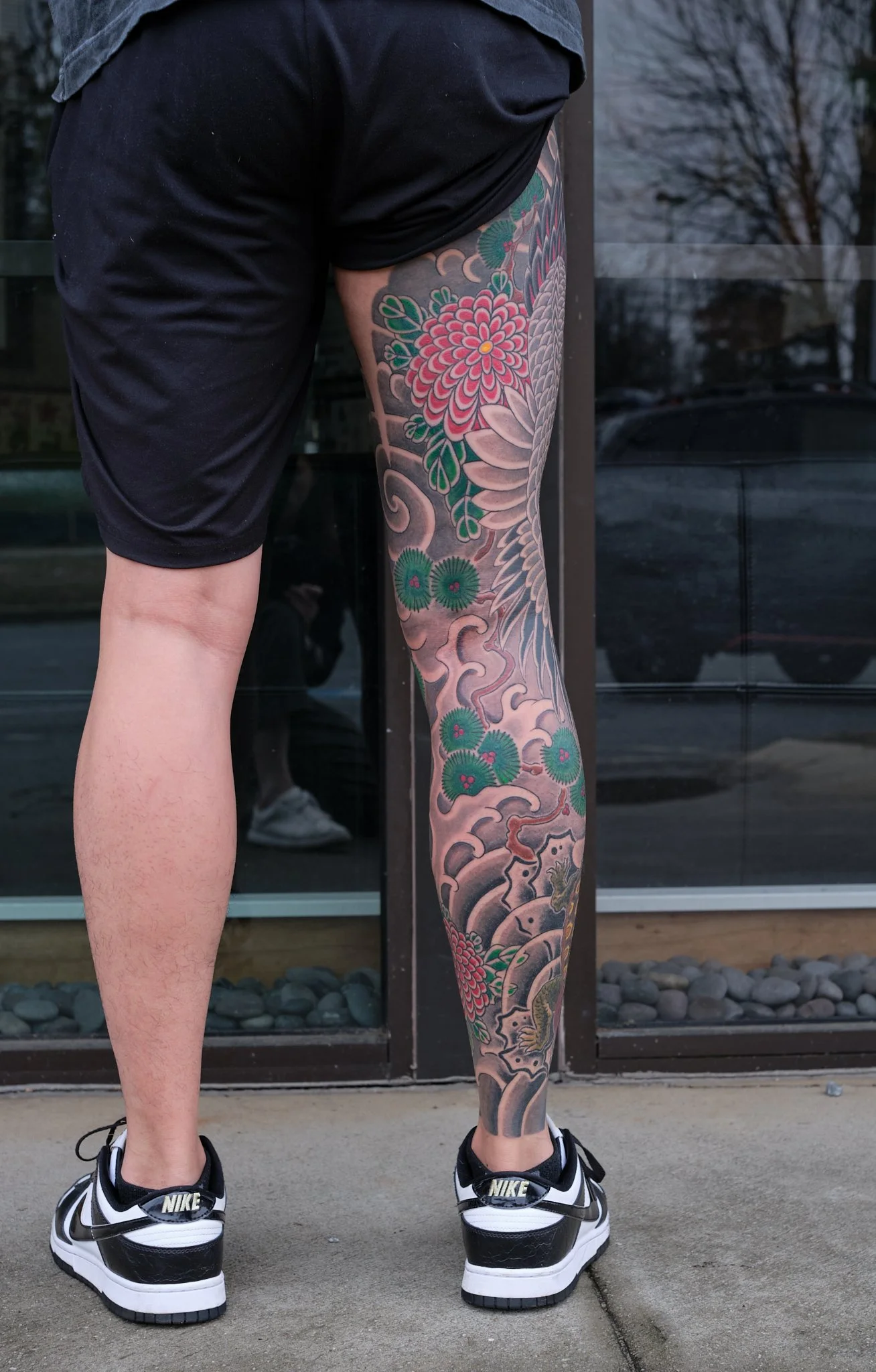
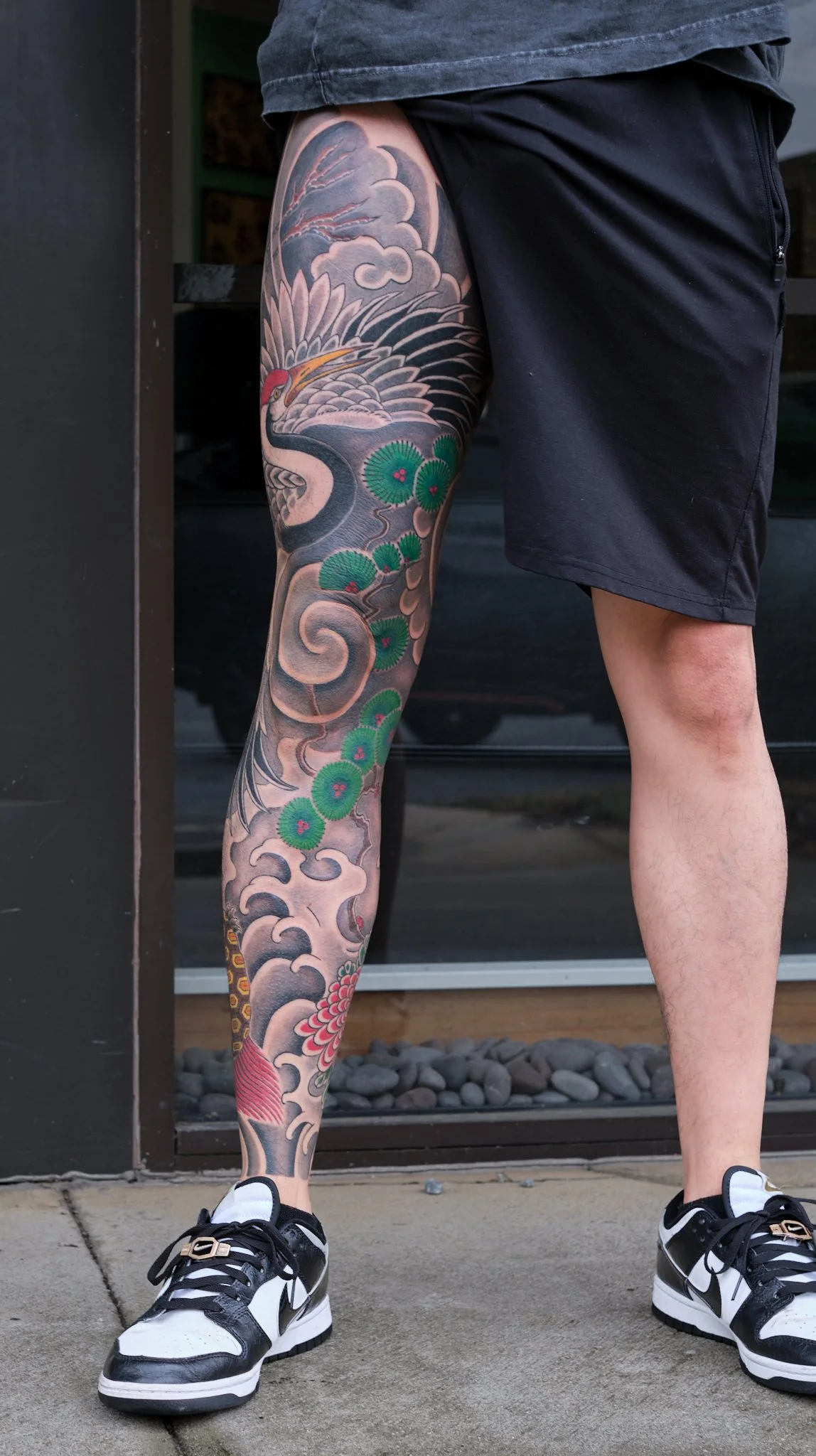

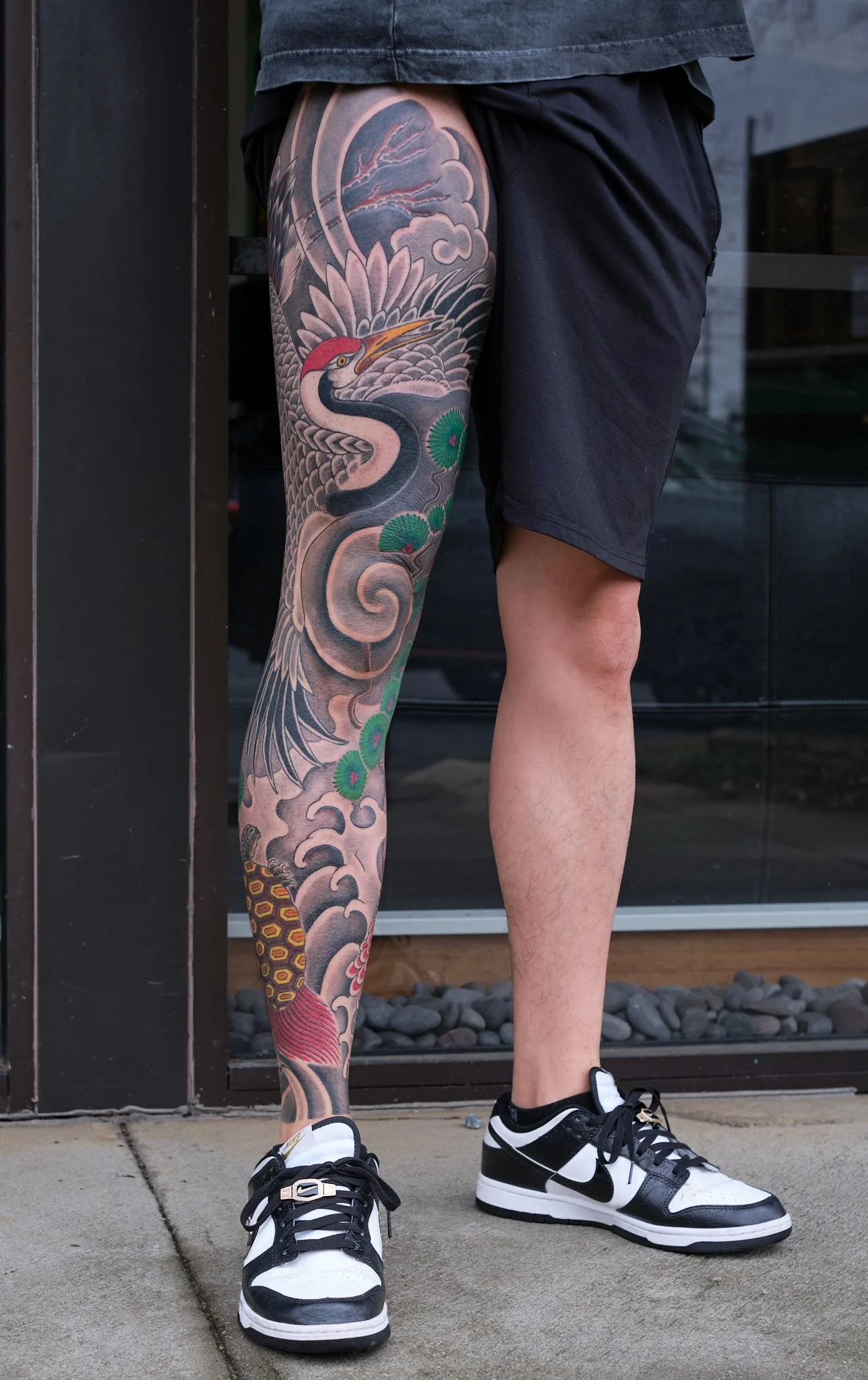
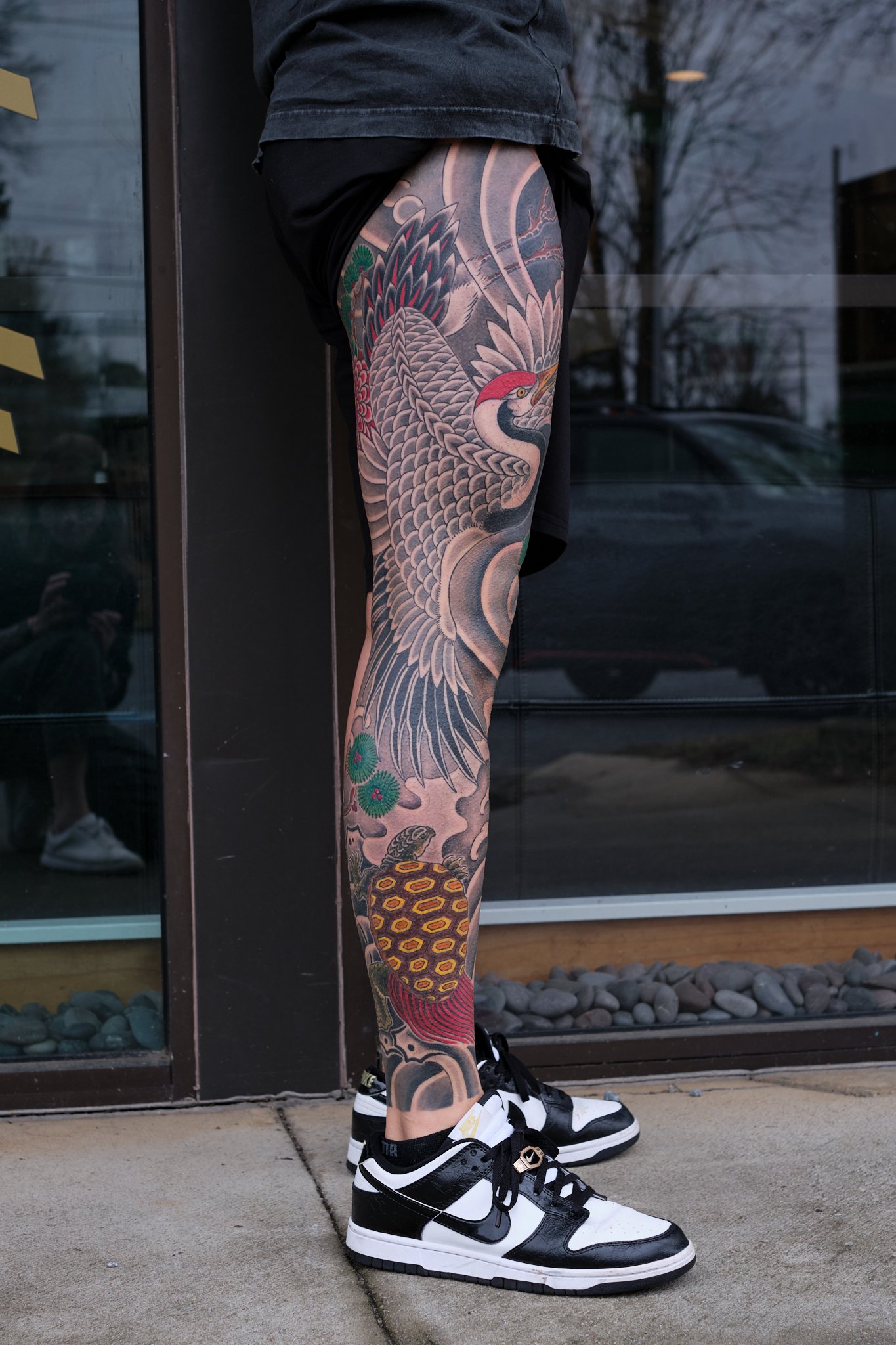
The work on this Japanese leg sleeves has spread between summer 2024 and winter of 2025 over the course of multiple sessions.
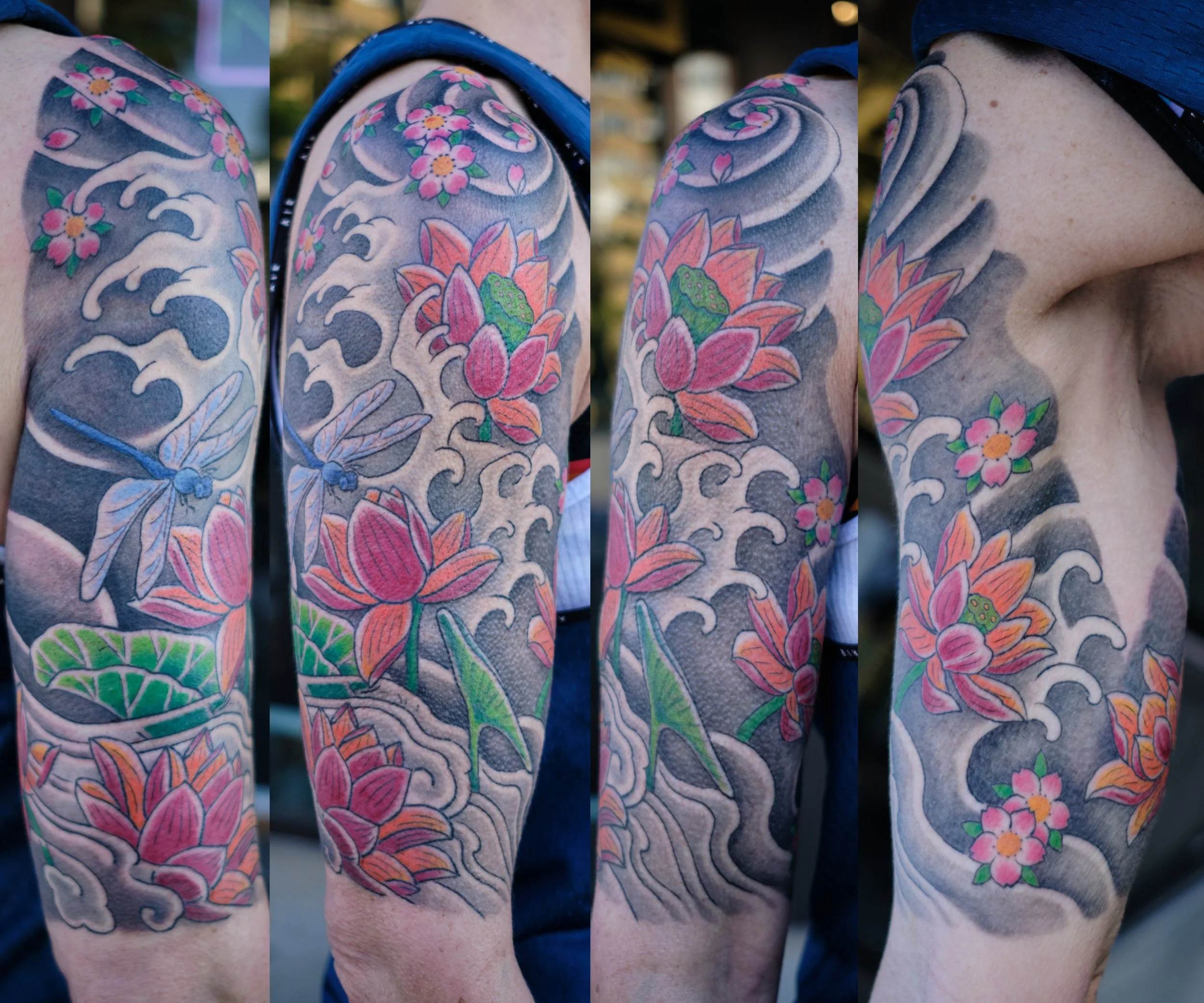
Japanese half-sleeve
featuring lotus flowers, cherry blossoms, and dragonfly
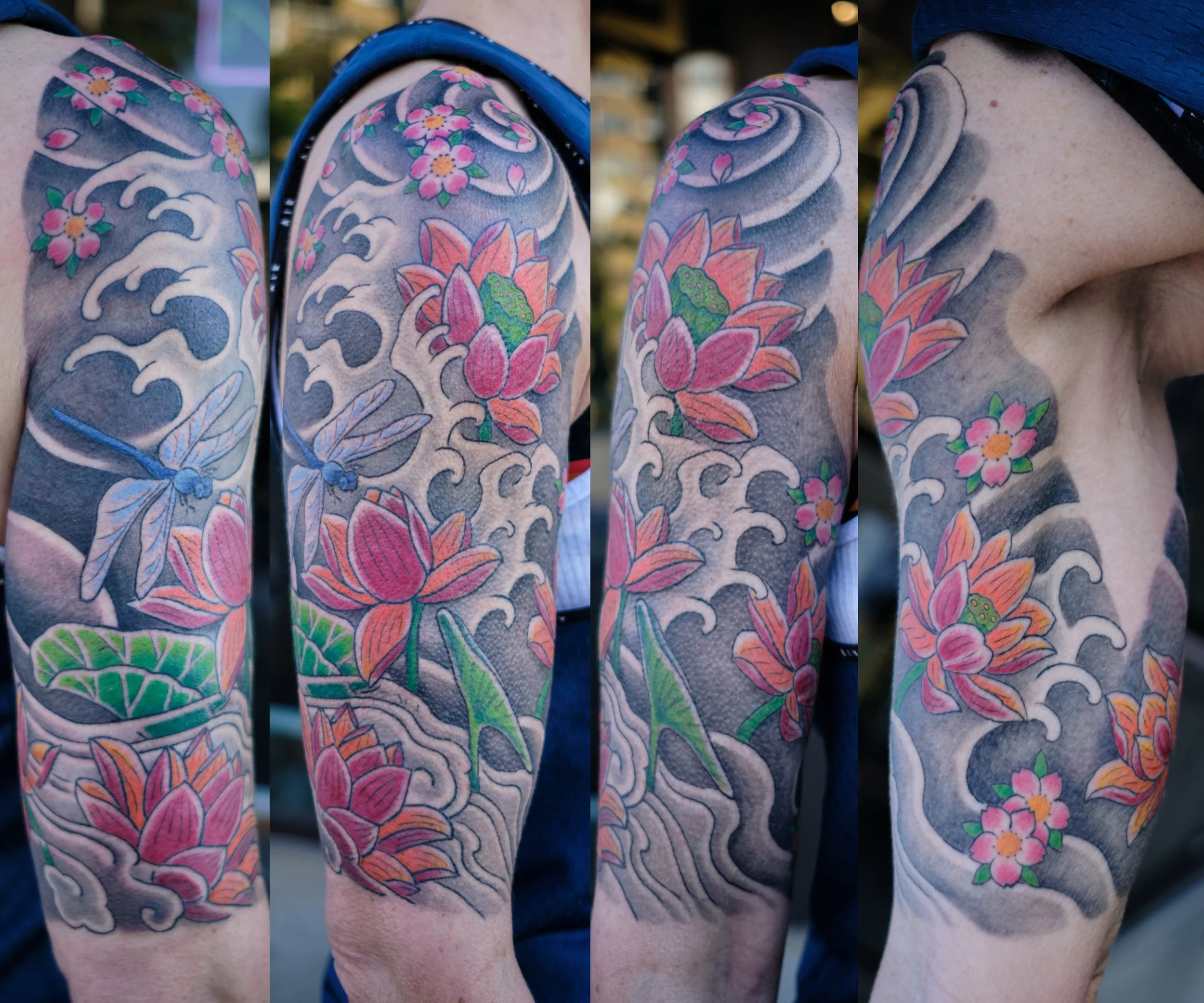
This half-sleeve was done in the spring of 2024. It took 3 full-day sessions, about 18 hours total. It features a dragonfly, several lotus flowers, cherry blossoms, water and wind bar background.
In irezumi, the dragonfly often symbolizes courage, strength, and happiness, typically associated with warriors for its representation of agility, victory, and adaptability. Lotus flowers represent purity, enlightenment, and rebirth, signifying the ability to rise above challenges and attain spiritual awakening. Cherry blossoms embody the transient nature of life, beauty, mortality, and the fleeting nature of existence, reminding us to appreciate the present moment. Together, these elements create a narrative of resilience, spiritual growth, and the appreciation of life’s fleeting moments.
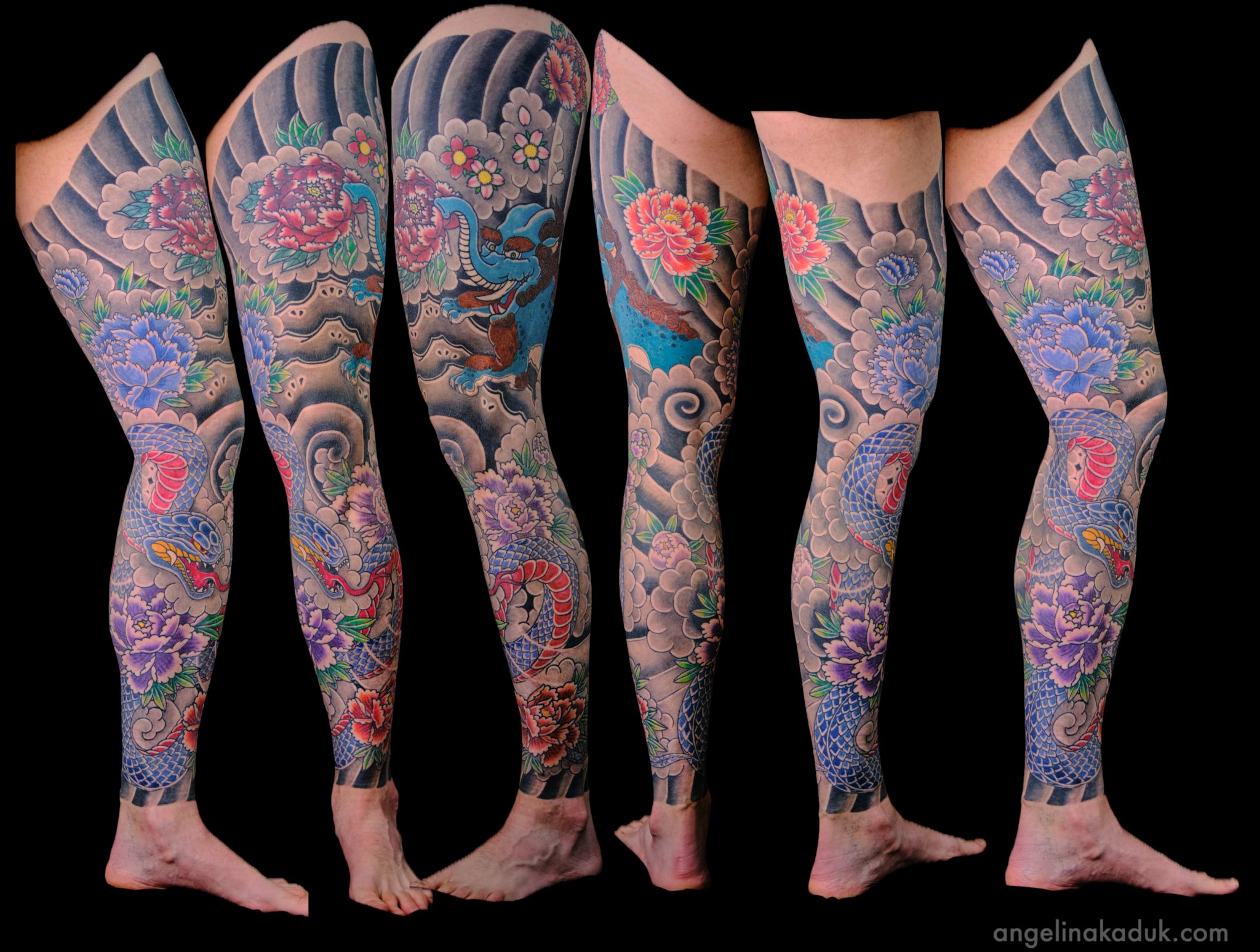
Full Japanese leg sleeve
featuring a snake, peony flowers, windbars, and the Baku yokai
This leg sleeve took a looooooong time to create. It started back when I was apprenticing in 2019, and the last coloring was done in December 2023, therefore it took a total of 5 years between the first and the last session to get it done.
The sleeve was worked on in short and rather infrequent sessions at both Bold City Tattoo in Jacksonville FL and Thunderbolt Tattoo in Atlanta GA.
The leg sleeve features some traditional irezumi motives like peony flowers, a snake, a Baku (dream eater) yokai, and traditional windbars in Sumi ink. Peonies are done in red, purple, and blue. The snake has blue scales and red belly, and Baku is done in teal color.


In traditional Irezumi tattoos, the Baku yokai is a cherished symbol of protection and tranquility. This mystical creature, often depicted with the body of a tapir, features an elephant-like trunk, rhinoceros eyes, and an ox's tail, creating an enigmatic and captivating appearance.
The Baku's primary role in Irezumi is to devour nightmares and transform them into positive energy, ensuring peaceful sleep and warding off malevolent forces. This symbolism makes the Baku a popular choice among those seeking both aesthetic beauty and spiritual significance in their tattoos. Typically depicted in dynamic poses, the Baku may be shown in action, with its trunk extended to consume nightmares or its mouth wide open, ready to devour negative energies.
Japanese dragon & rooster half-sleeve
This Japanese half-sleeve was done between March and May of 2022 over the course of 6 sessions, about 28 hours total, and is done with traditional Japanese Sumi ink.
The piece features a rooster and a dragon. In Irezumi, both the rooster and the dragon hold significant symbolic meanings, deeply rooted in Japanese culture and mythology.
The rooster in Irezumi is often associated with courage and bravery. This stems from the bird's natural behavior of fearlessly defending its territory and flock. Roosters are also symbols of good fortune and are thought to ward off evil spirits. In some Japanese folklore, the rooster's crow is believed to chase away malevolent spirits, as it heralds the arrival of the sun and dispels darkness and evil. Additionally, the rooster is admired for its vibrant plumage, which translates into colorful and visually striking tattoo designs.
The Japanese dragon, or ryu, is a highly revered mythical creature in Japanese culture, symbolizing strength, wisdom, and the power to protect. Unlike Western depictions of dragons as malevolent creatures, Japanese dragons are often considered benevolent and wise. They are associated with water, rain, and bodies of water, seen as guardians of these elements. In tattoo art, the dragon represents balance, freedom, and good luck, and it is often depicted in powerful, fluid motion, emphasizing its connection to the natural world.
When combined in a single Irezumi design like the one in this tattoo, the rooster and dragon can represent a balance of forces—bravery and wisdom, physical strength and spiritual power.
Japanese crane half-sleeve
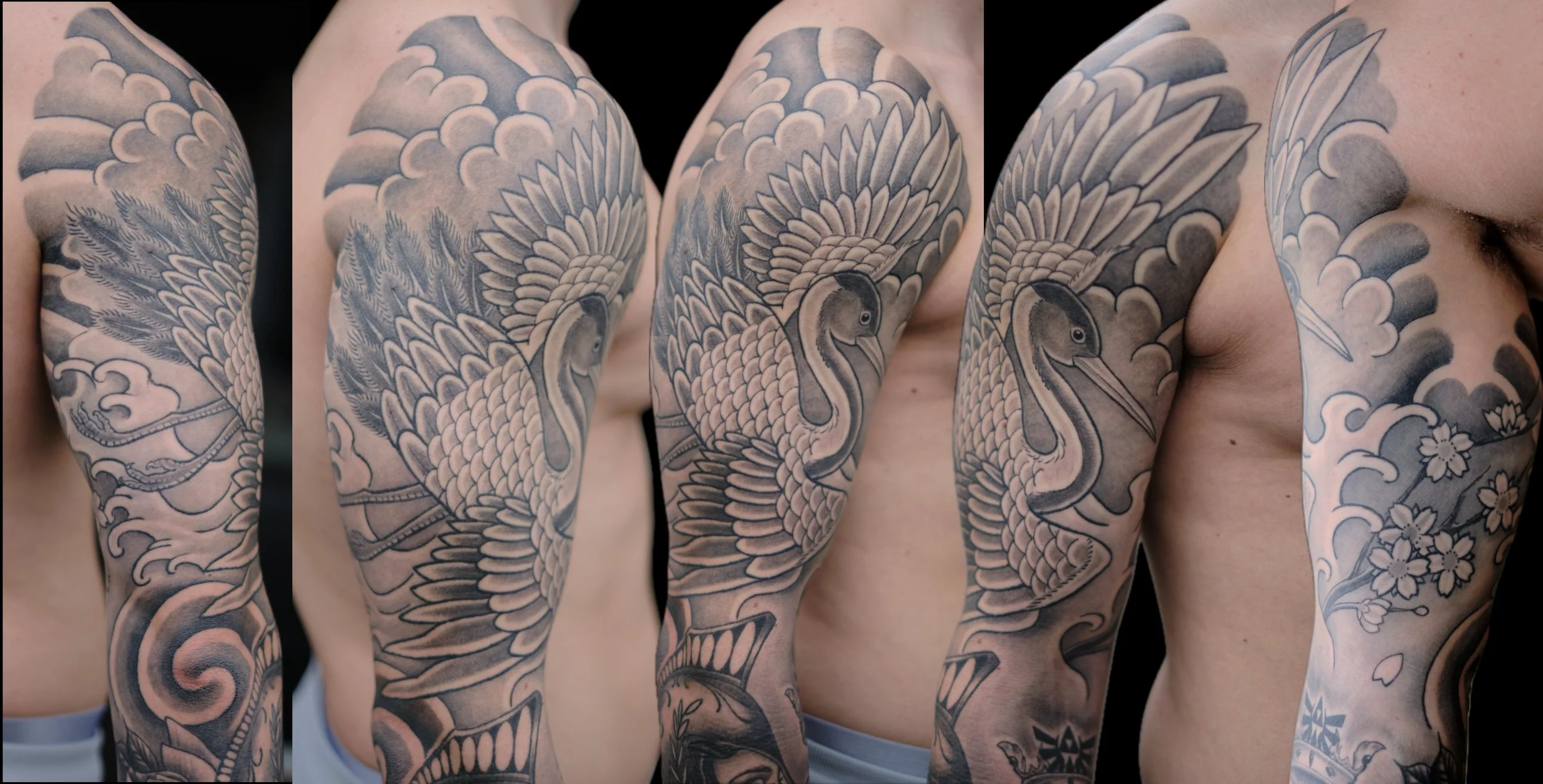
This tattoo was done in February-May of 2023 here at Thunderbolt Tattoo in Atlanta GA. We’ve completed the piece over the course of 3 sessions, 18 hours in total.
The customer already had an existing tattoo on their forearm: the real estate I was working with the arm at elbow and above the elbow all the way to the shoulder.
Although like most things in Irezumi cranes are more often done in color, the client preferred an black & grey version, allowing it to merge with client’s existing black & grey ink.
In the realm of Irezumi, cranes hold a special place, embodying a rich tapestry of cultural symbolism. These majestic birds are revered for their association with life's enduring qualities. With their graceful appearance and remarkable longevity, cranes symbolize not only a wish for a long and prosperous life but also the elegance that accompanies such a journey.
Beyond their symbolic role as harbingers of good fortune and longevity, cranes are revered for their monogamous nature, representing fidelity and purity in relationships. Their ability to gracefully traverse the skies, covering vast distances with unwavering endurance, speaks to qualities of resilience and the power to overcome life's challenges.
Crane tattoos are chosen not only for their profound symbolism but also for their aesthetic allure. These tattoos, often executed in a realistic style, capture the essence of these magnificent creatures. Whether portrayed alone or in harmonious conjunction with other traditional Japanese motifs like cherry blossoms, dragons, or koi fish, crane tattoos resonate with individuals on a deeply personal level, reflecting a desire for a life filled with fortune, grace, and enduring beauty.
In this tattoo piece, the crane was the main focus. However, we did add some cherry blossoms to the inner side of the arm to complement the crane.
The photos of the tattoo are fully healed and about 4 months after the last session - I was able to take photos when client stopped by the shop.
I love creating Japanese-style tattoos - this is by far my most favorite style! I am also extremely glad to be working alongside Joe Vegas and being able to consult with him any time I have a question or need a second opinion. I couldn’t have asked for a better mentor!
Hit our shop up or complete my booking form for your next Irezumi needs!
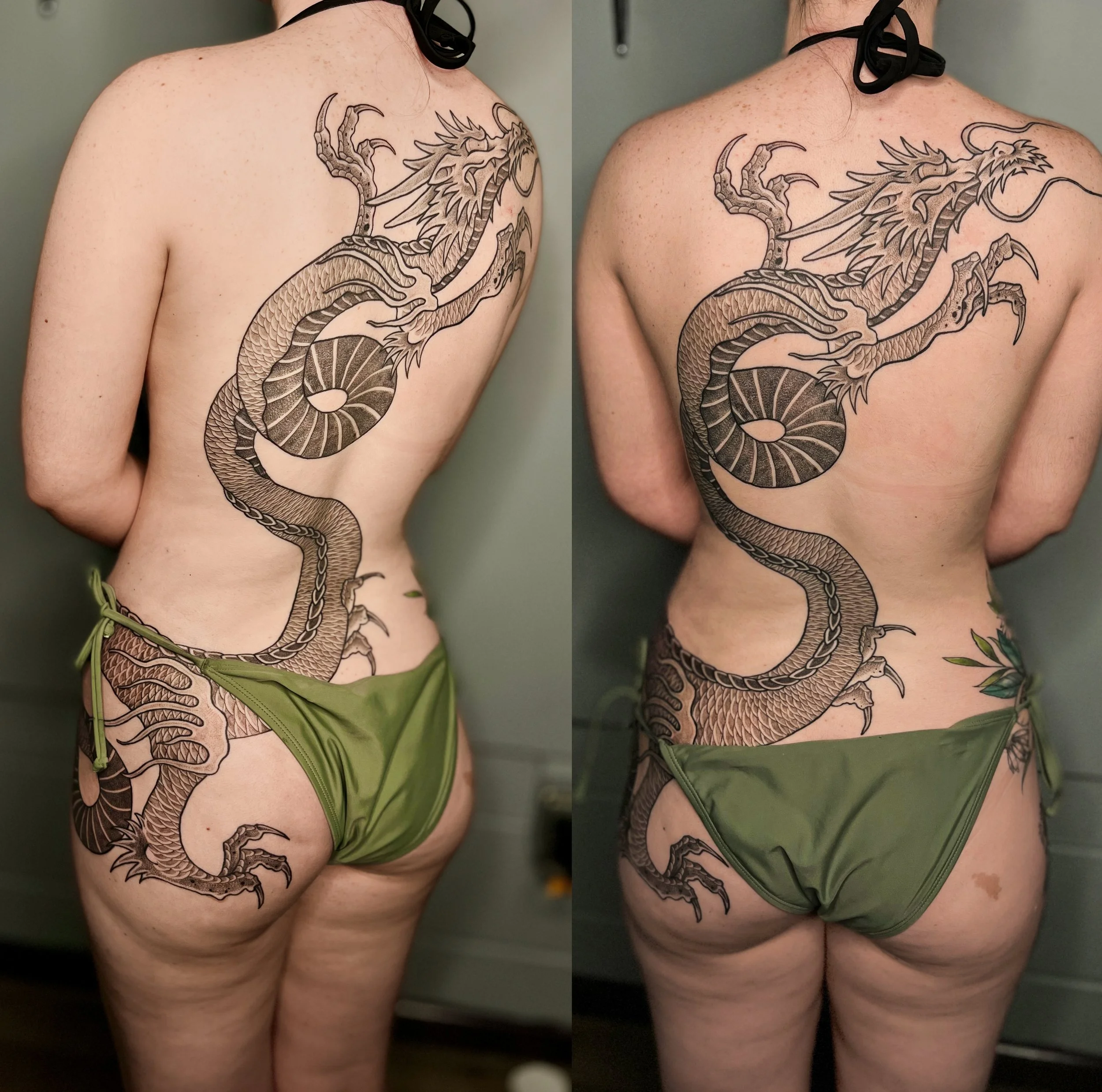
Dragon back and thigh piece

This tattoo piece was completed in June - July 2022 over the course of 5 sessions, 23 hours total, at Thunderbolt Tattoo in Atlanta GA. The tattoo is done in mixed style: primarily Japanese, with stipple shading.
Various Japanese tattoos
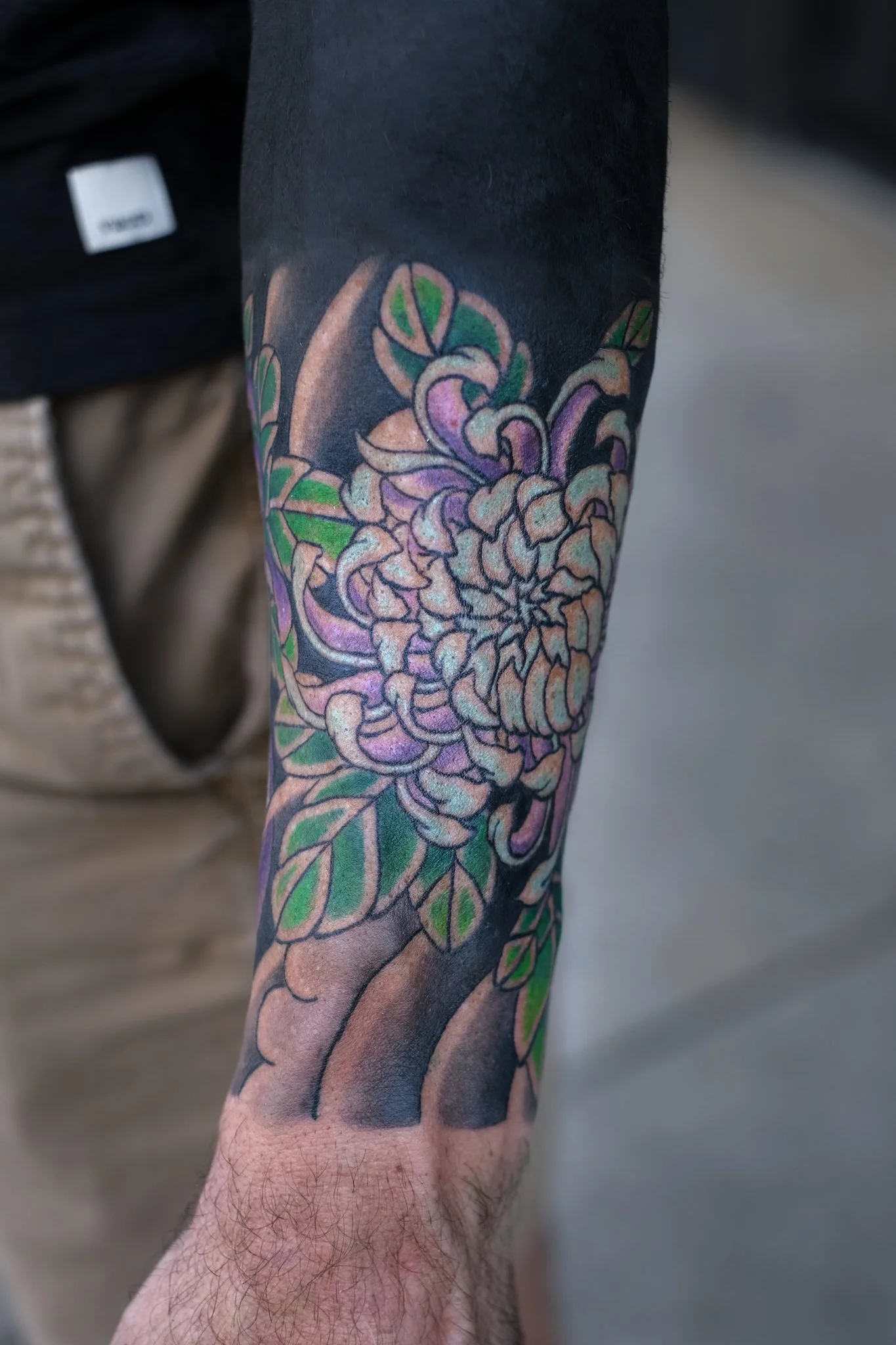
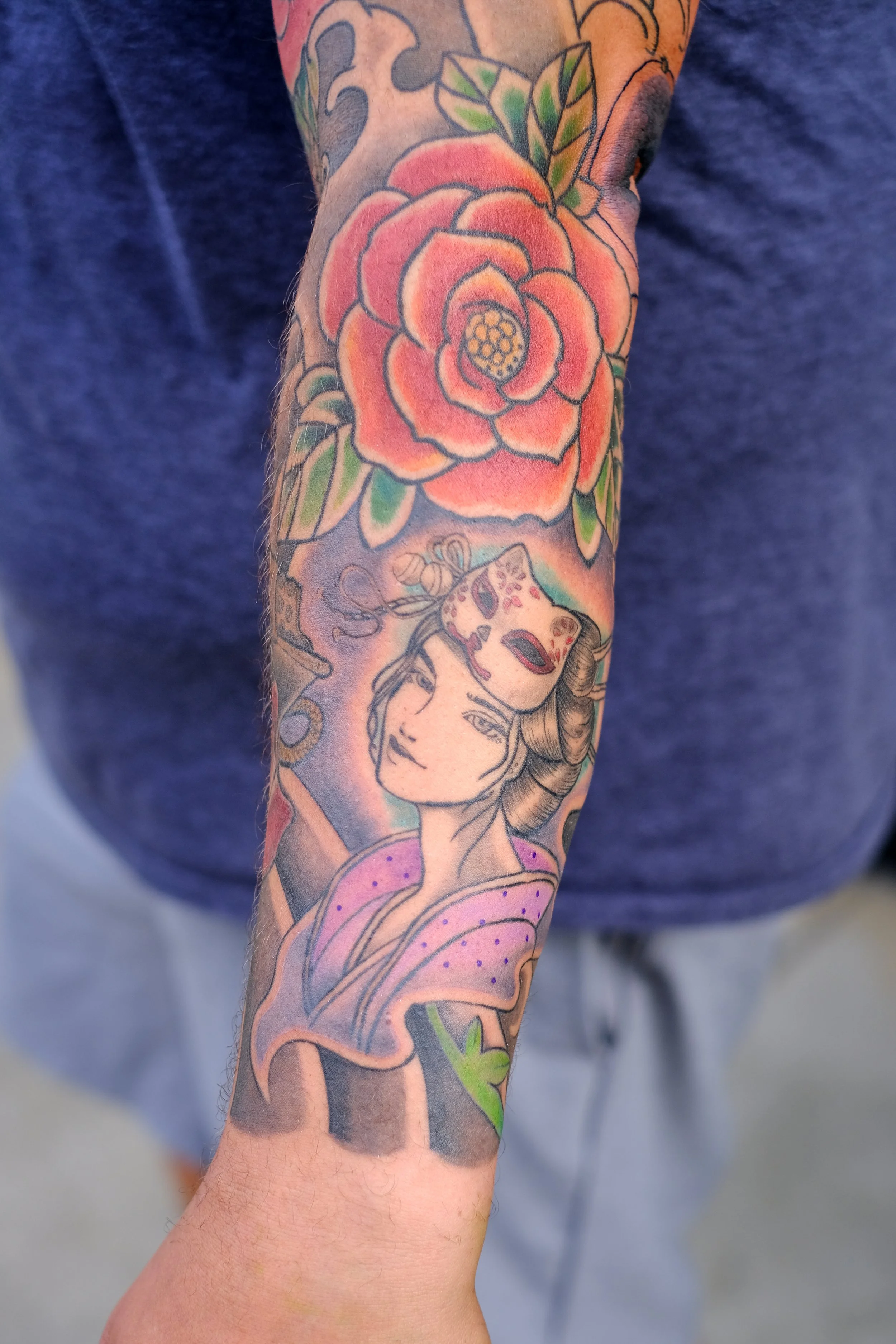
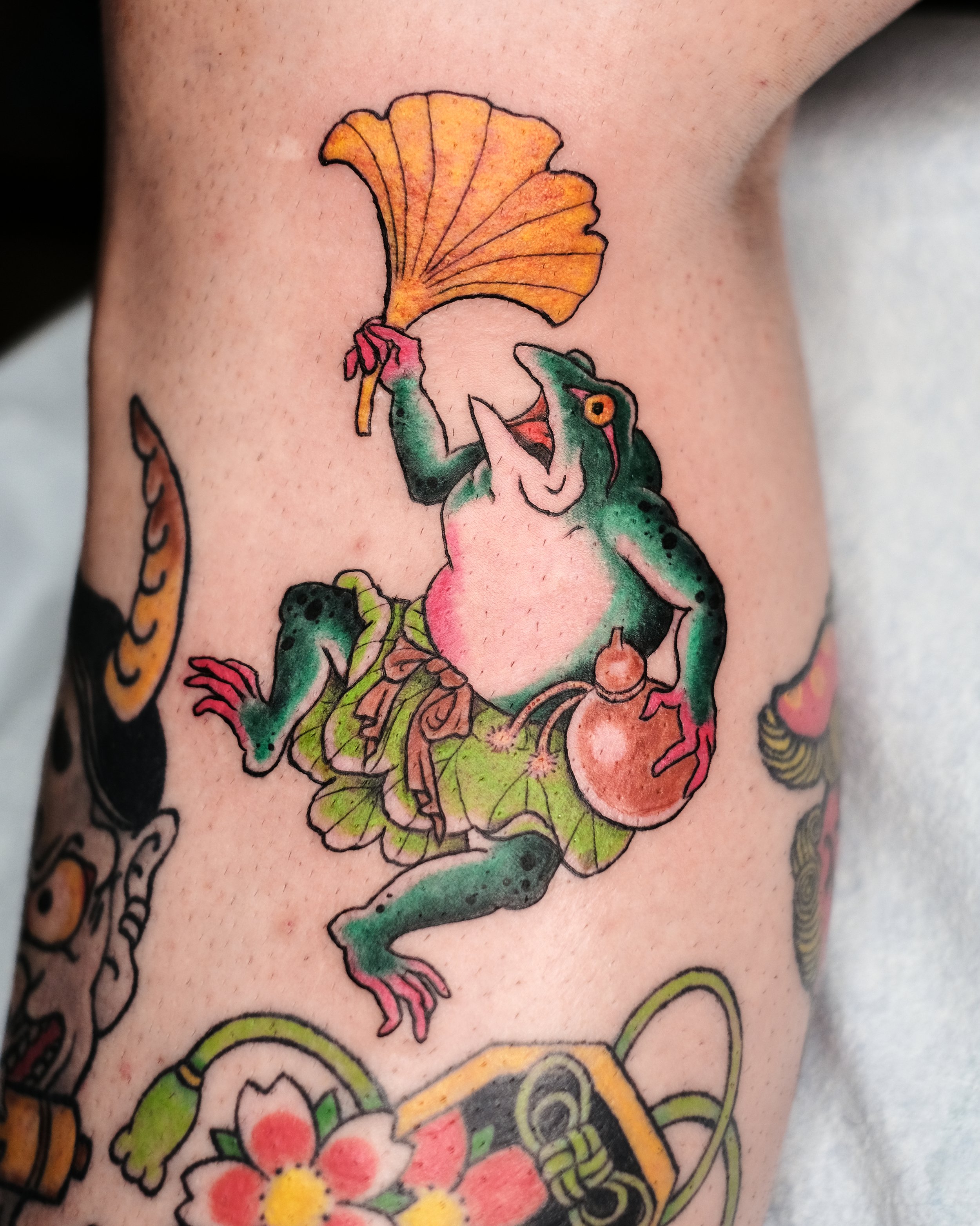
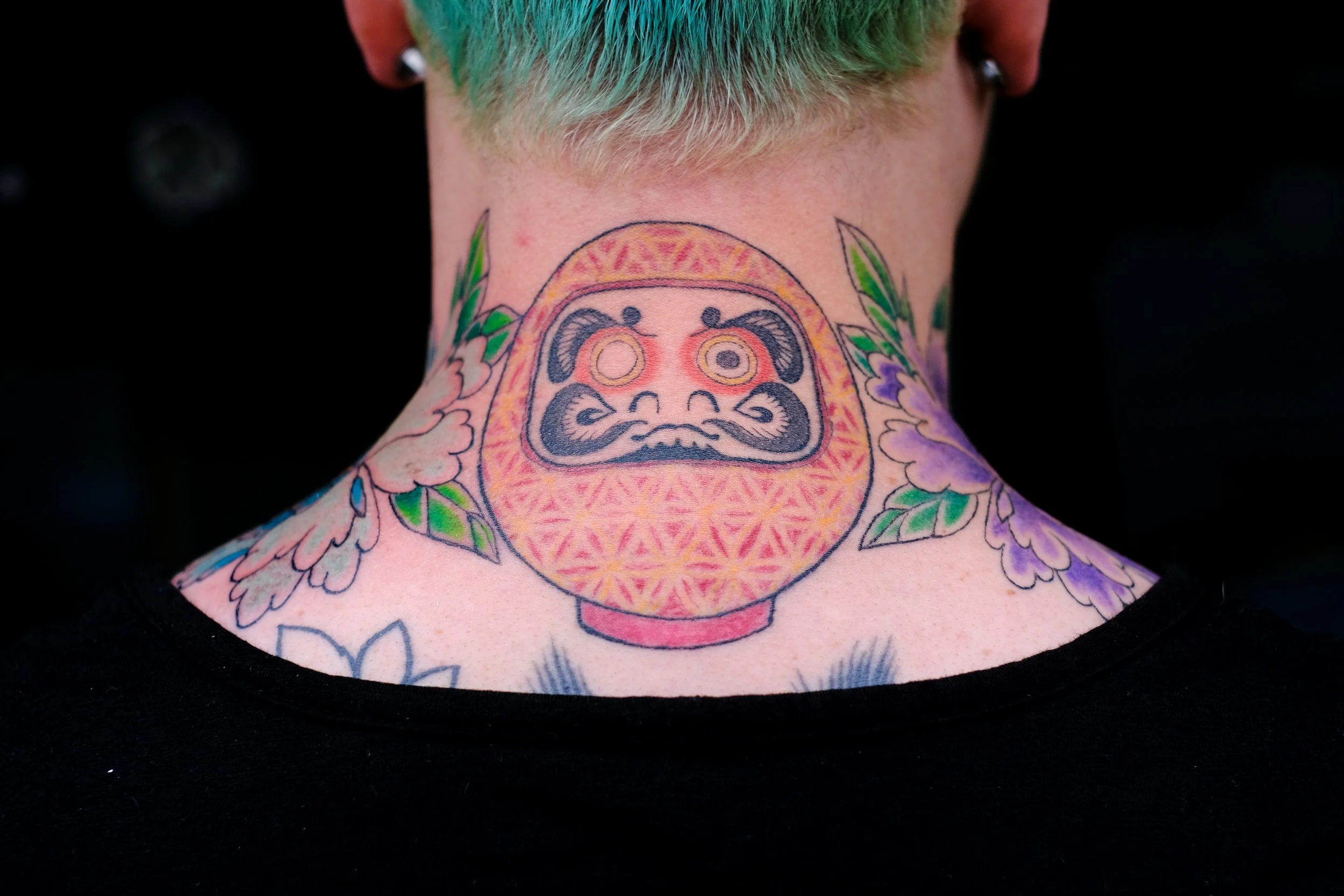
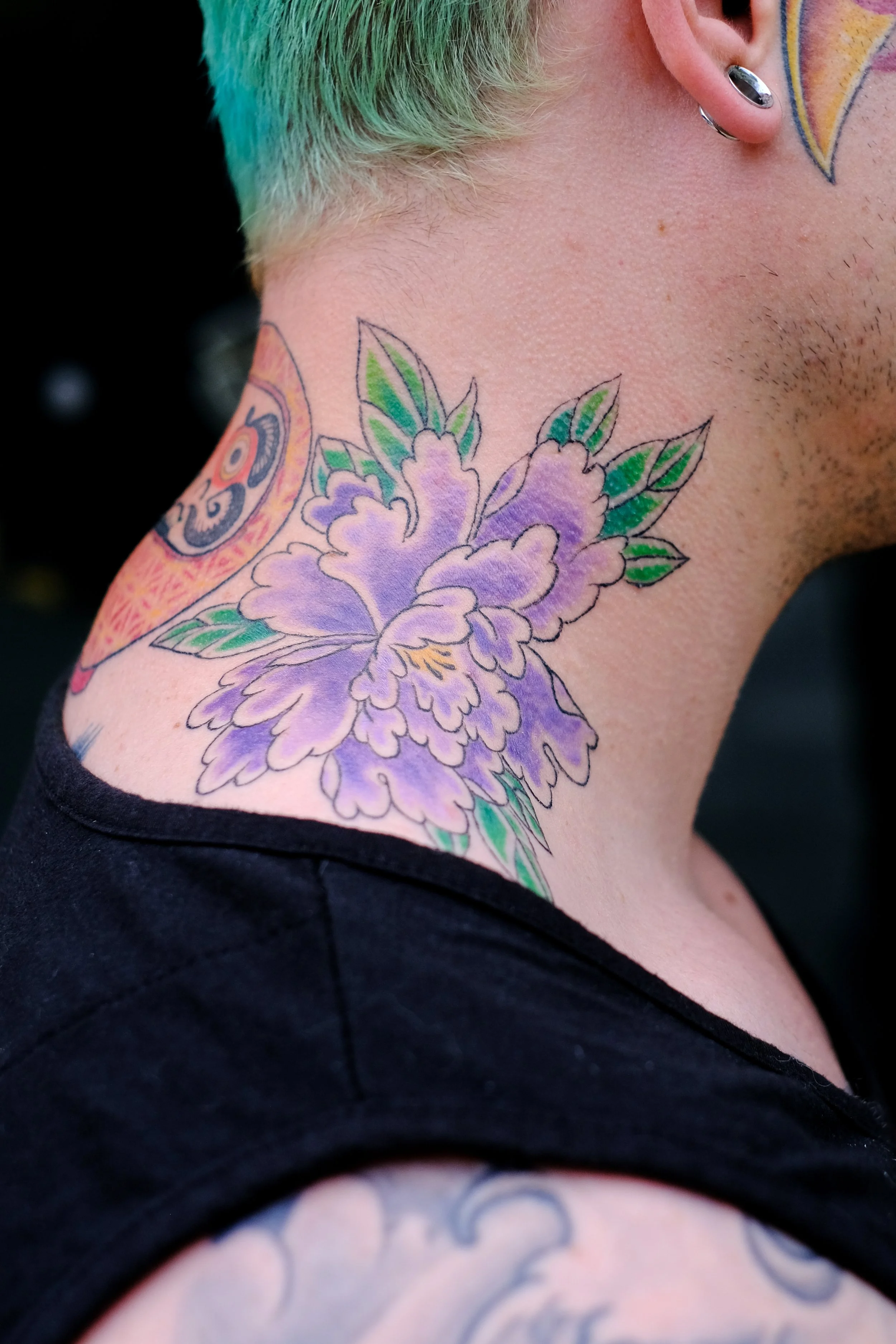
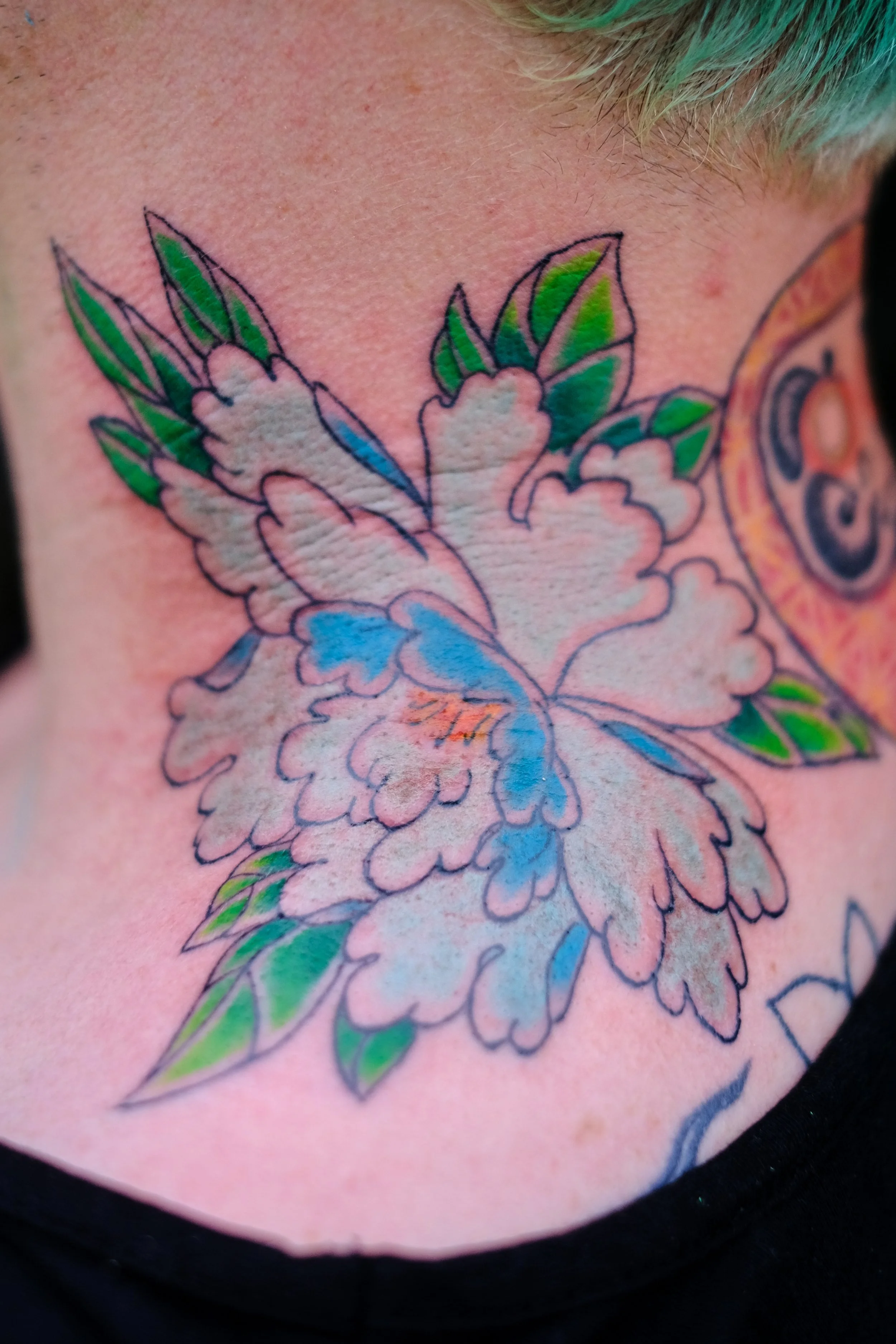
Below are some of the smaller tattoo pieces I’ve done inspired and guided by Irezumi - Japanese tattoo tradition and art: yokai and mythical creatures, samurai heads and masks, animals like tigers, frogs, and koi fish, traditional flowers, daruma dolls, and everything else. I especially enjoy tattooing Japanese yokai, as each of them has a fascinating supporting legend.
For instance, Nure-onna (濡女, "wet woman") is a Japanese yōkai which resembles a reptilian creature with the head of a woman and the body of a snake. They are also seen as a paranormal phenomenon at sea under the name of nureyomejo. In legends, they are often said to consume humans, but they have no single appearance or personality.



History of Irezumi
Irezumi, the traditional Japanese tattoo art, has a rich history that dates back to the Yayoi period (300 BC - 300 AD). Initially, tattoos in Japan were used for spiritual purposes and to mark criminals. By the Edo period (1603-1868), irezumi evolved into a sophisticated art form, often featuring intricate designs of mythical creatures, gods, and nature motifs. These tattoos were popular among the working class, including firemen and manual laborers, as symbols of strength and protection. Irezumi’s distinctive style and cultural significance caught the attention of Westerners in the late 19th and early 20th centuries, leading to its spread globally. Today, irezumi remains highly respected for its artistry and deep cultural roots, influencing contemporary tattoo practices worldwide.
The exchange of irezumi with Western artists began in earnest during the late 19th century when Japan opened its borders to international trade and interaction after the Meiji Restoration. Western sailors, merchants, and travelers visiting Japan were fascinated by the elaborate tattoo work and began getting tattoos from Japanese masters. Prominent irezumi artists like Hori Chyo and Horiuno were known to tattoo foreign clients, which helped spread the art form to the West. This collaborative process involved Western artists learning traditional Japanese methods, such as tebori (hand-poking), and integrating these into their own practices, while Japanese artists adopted some Western tools and equipment, like electric tattoo machines.
Notable American tattoo artists, such as Sailor Jerry (Norman Collins) and Ed Hardy, played significant roles in this cultural exchange. Sailor Jerry, stationed in Hawaii, was heavily influenced by Japanese tattoo art and incorporated its elements into his designs. Ed Hardy, a protégé of Sailor Jerry, studied under renowned Japanese tattoo master Horihide, further blending Eastern and Western tattoo traditions. Modern Japanese tattoo artists like Horiyoshi III continue to inspire and influence global tattoo art with their masterful work.
This interaction is viewed as cultural sharing rather than appropriation due to the mutual respect and acknowledgment of the art form’s origins. Western artists typically honor the traditional aspects of irezumi and often study its cultural and historical significance deeply. They maintain the integrity of the designs and methods, ensuring that the cultural heritage is preserved and celebrated rather than exploited. This respectful exchange has fostered a global appreciation for irezumi, blending artistic traditions while honoring their roots.