
Japanese Tattoos - Atlanta GA
Japanese is my favorite style of tattooing! I’ve always been drawn to Japanese culture, and the art of Irezumi has always fascinated me, with its rich history, mythology, and traditions. I’ve done multiple standalone pieces, half-sleeves, 3/4 sleeves, full sleeves (both arm and leg), a few back pieces, and with several full bodysuits currently in the works. On this page, you’ll find some of my favorite Japanese tattoos I’ve done.


What a Japanese project actually involves
Standalone piece: 1-2 sessions, 3-6 hours
Half sleeve: 3-5 sessions, 15-20 hours
Full arm sleeve: 5-8 sessions, 30-45 hours
Full leg sleeve: 10-14 sessions, 60-80 hours
Back piece / bodysuit: Let's talk!
My full-day sessions are 6 hours, but I schedule around your availability and preference, and can do shorter sessions if needed. For full sleeves & beyond, a lot depends on the size of the work and the design: we can work on a more specific price during the inquiry process - fill out this form to get started.
Large projects take time and can run across months, sometimes years. One leg sleeve on this page took five years, start to finish, because we worked when life allowed. I will work with your schedule and budget to make sure we are able to move the project along at the pace that works for you.
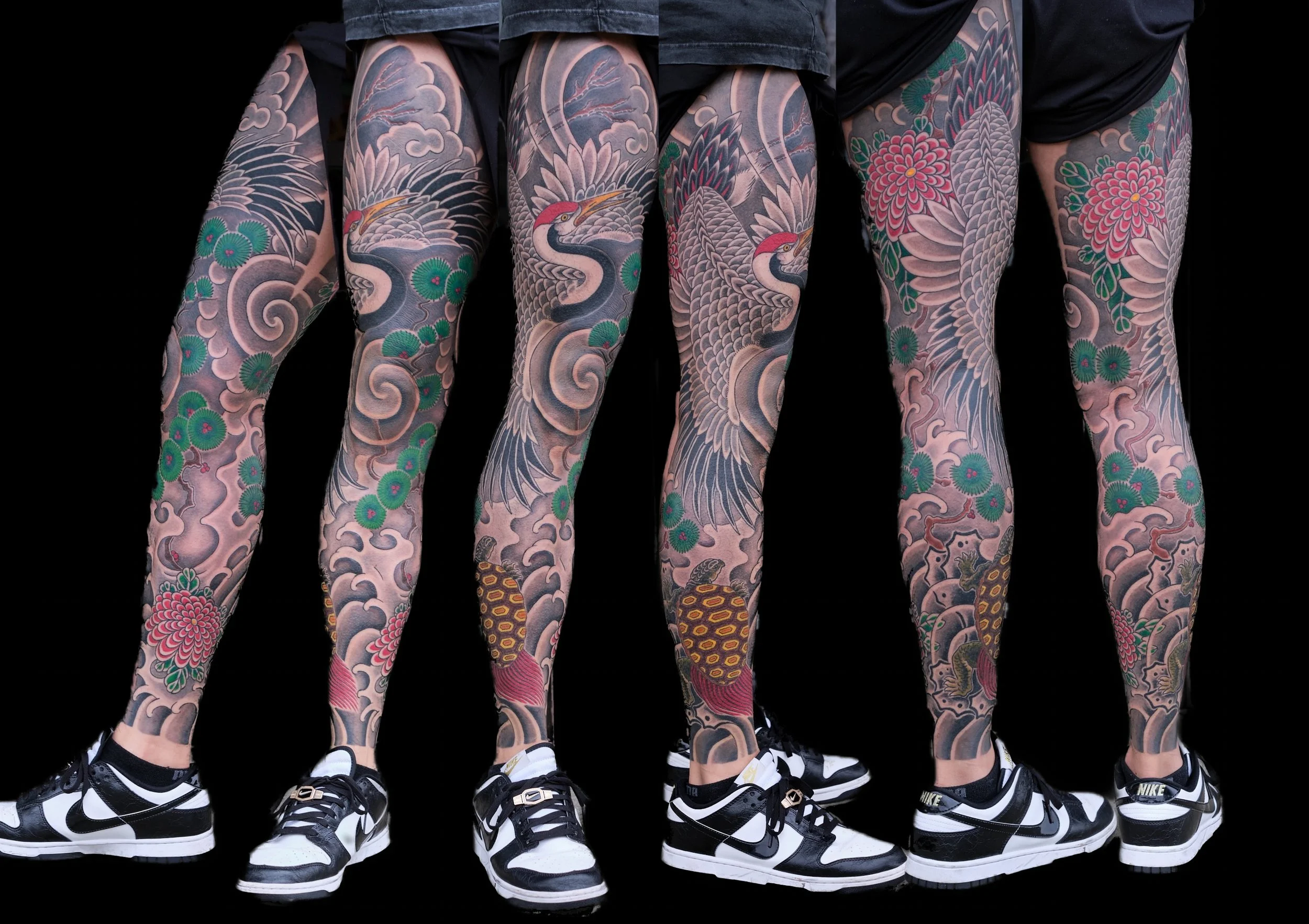
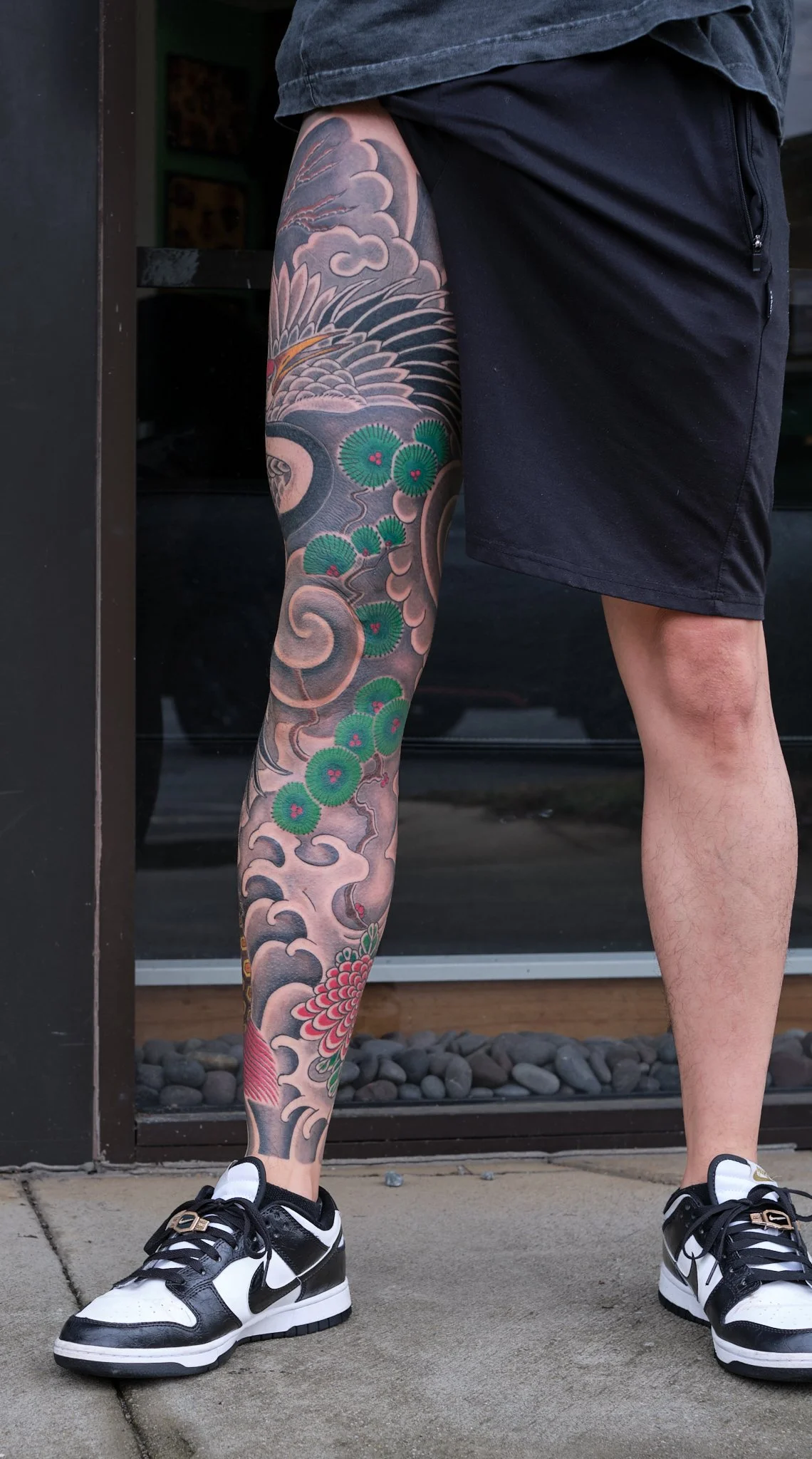
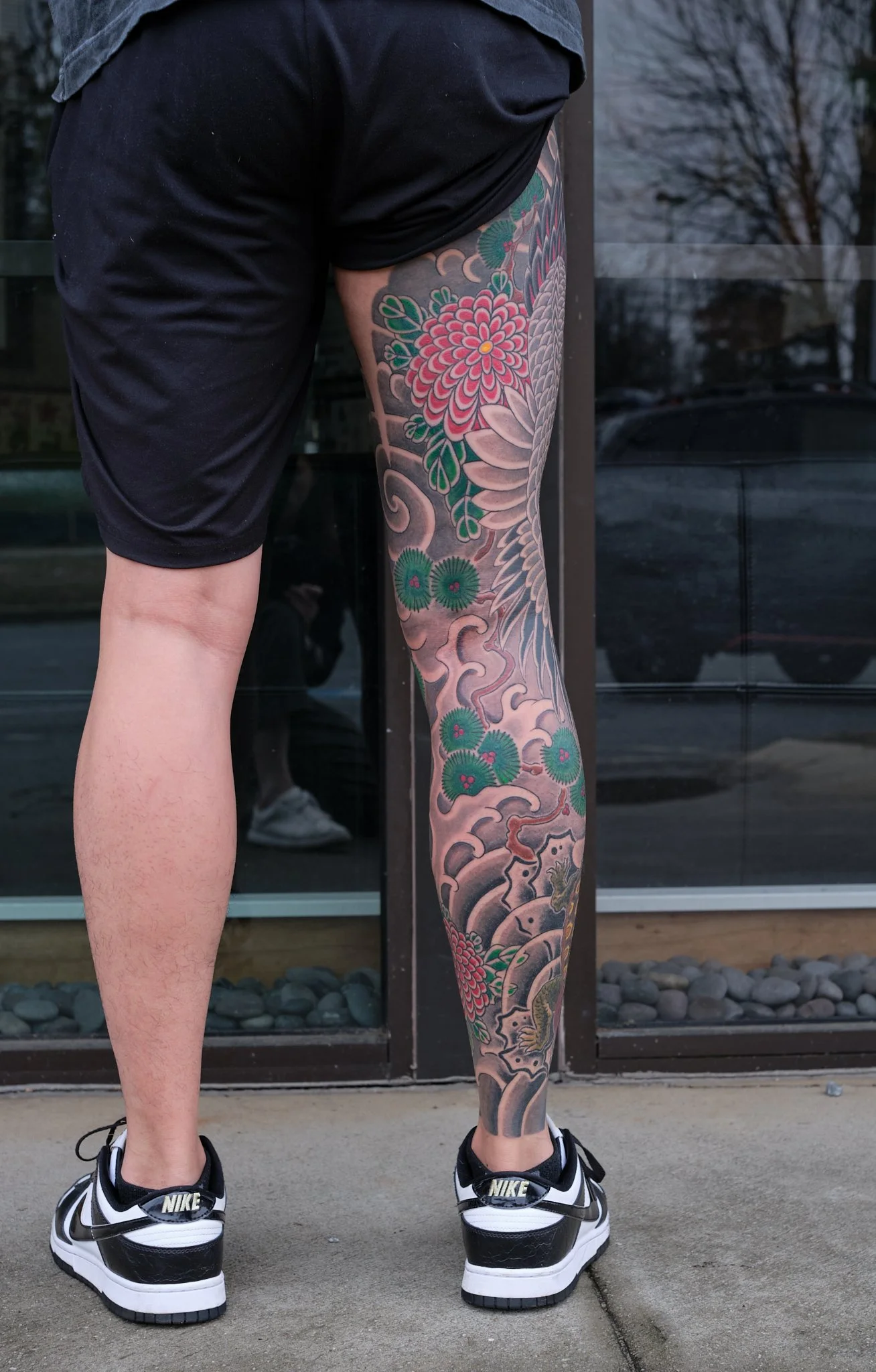
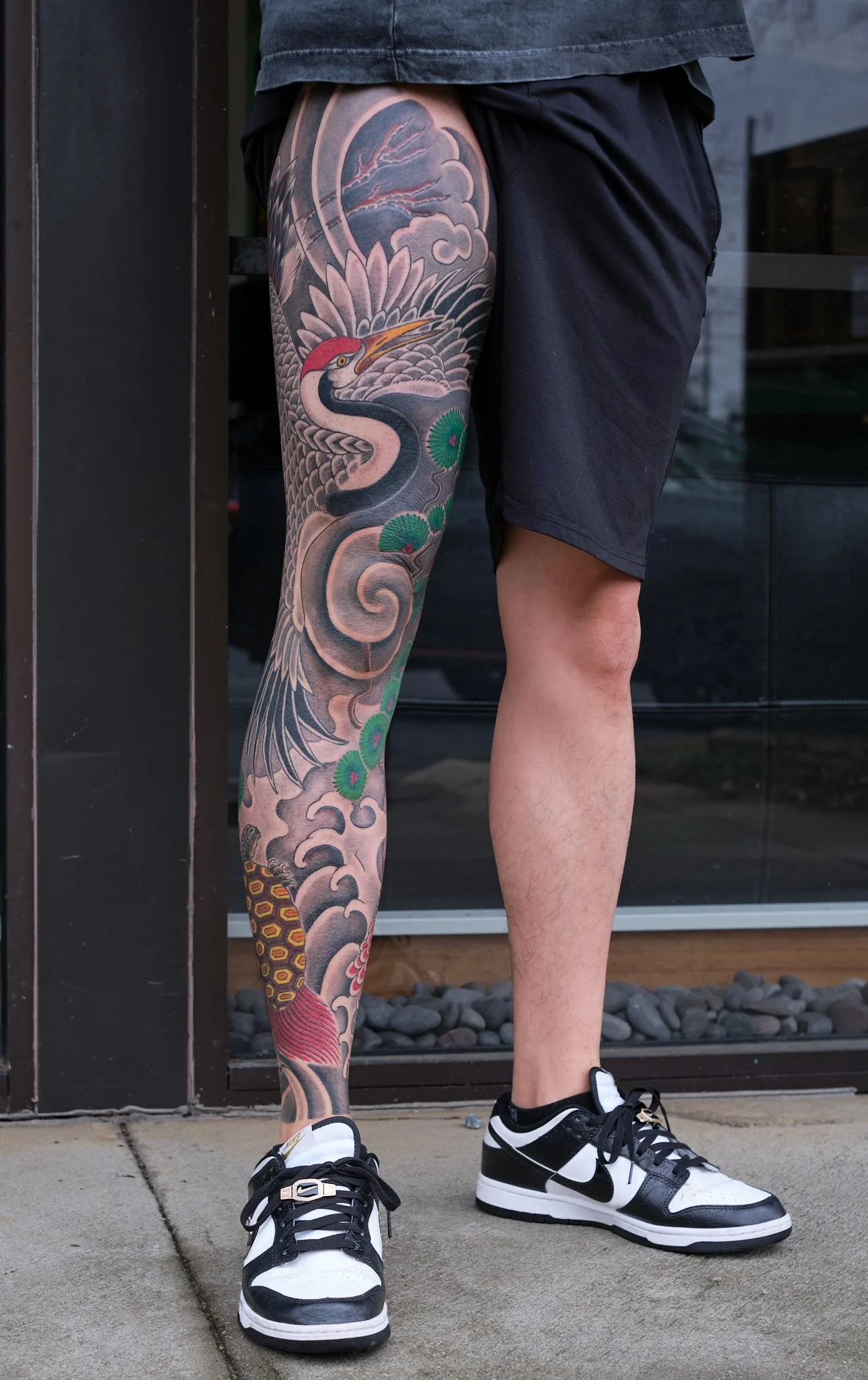
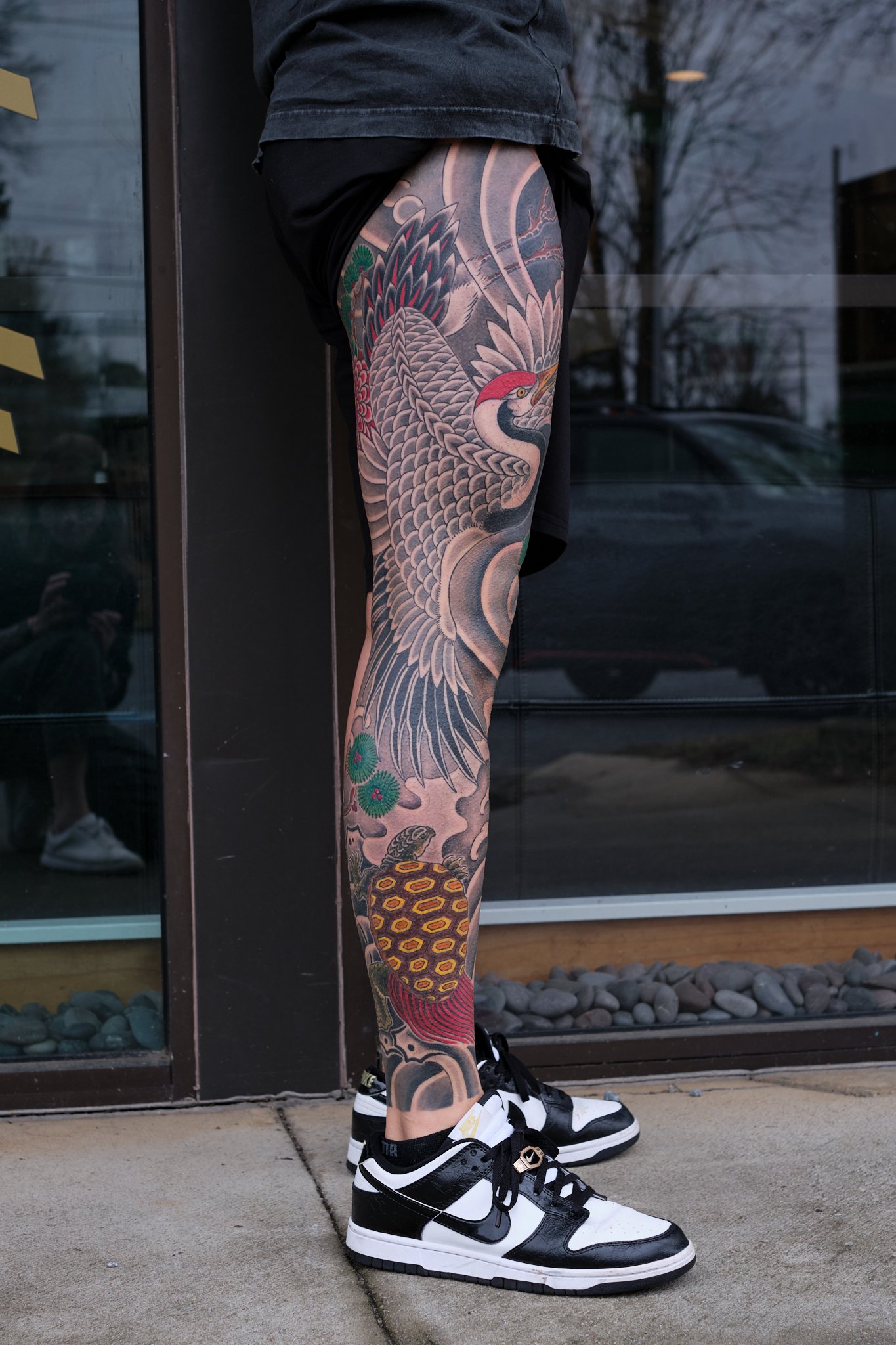
Full Leg Sleeve: Tsuru, Minogame & Chrysanthemums
A crane moving through clouds down the length of the leg, a minogame — the ancient turtle, its tail grown over with weed — at the base, chrysanthemums scattered through. Longevity, endurance, and renewal, which is about as complete a set of ideas as you can put on one leg.
This is the piece I'd show someone who wants to understand how a Japanese sleeve is supposed to hang together as a single composition rather than several good tattoos in a row.
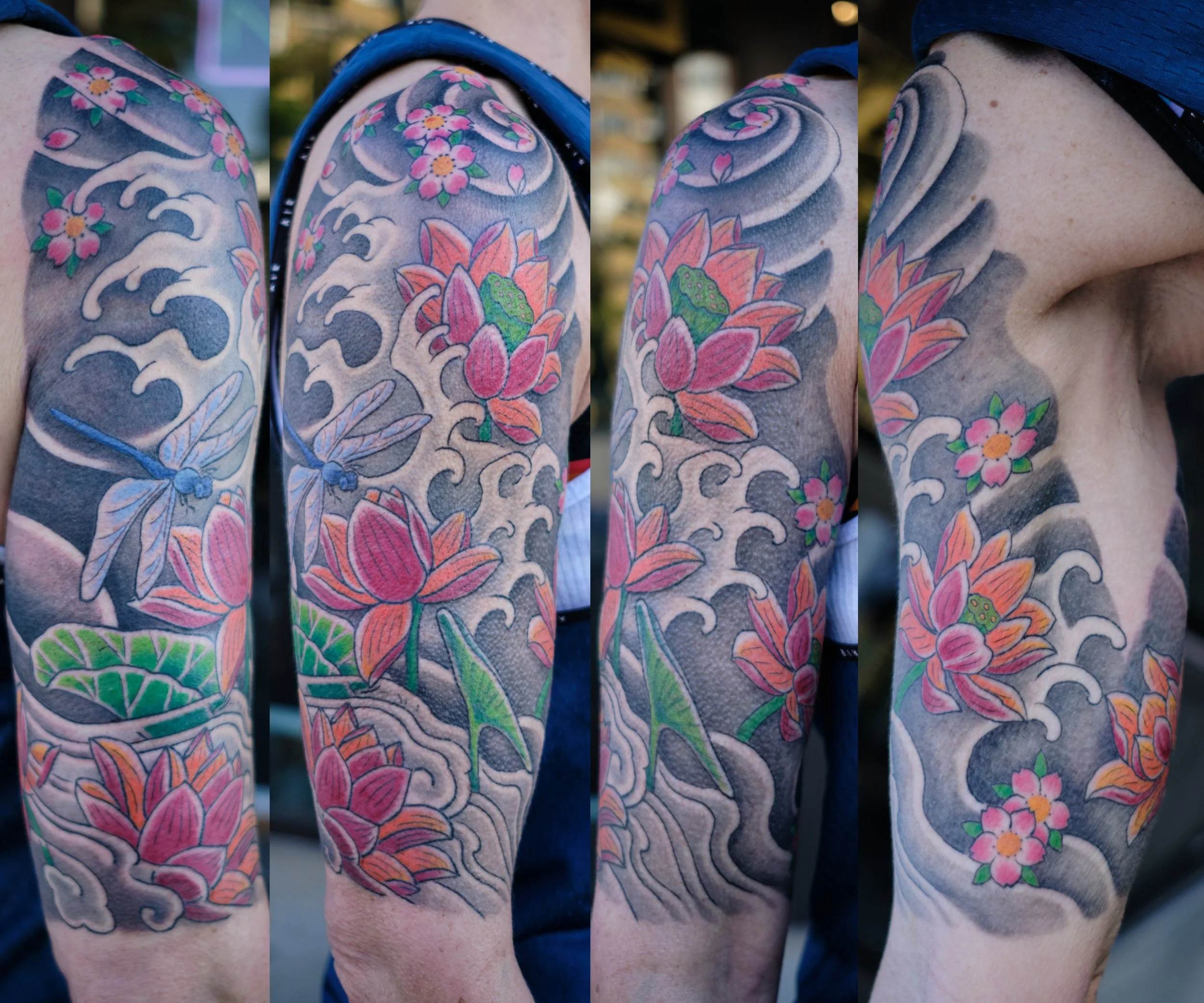
Japanese Half Sleeve: Lotus, Cherry Blossom & Dragonfly
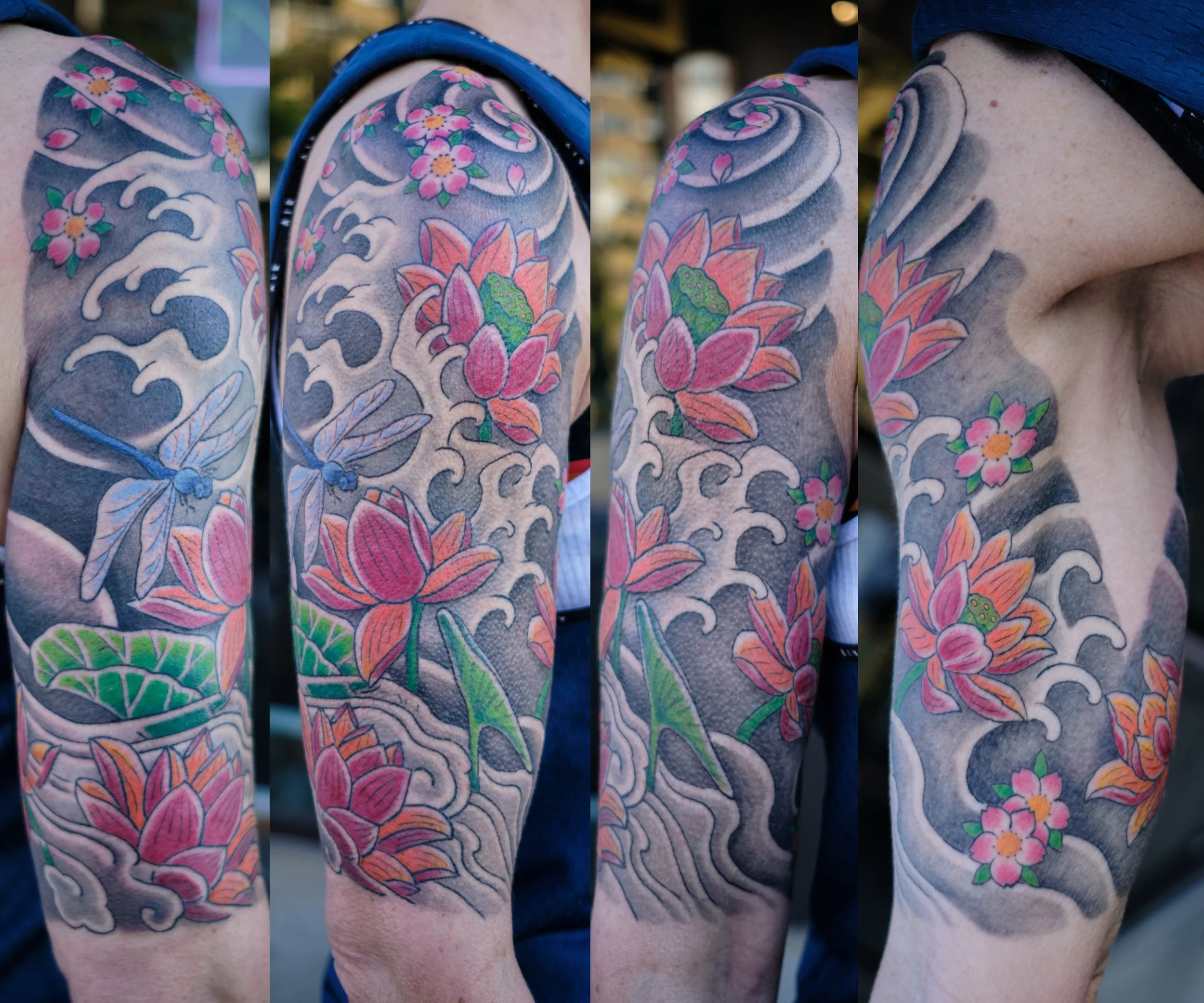
Spring 2024. Three full-day sessions, about 18 hours.
A dragonfly — courage and adaptability, historically a warrior's motif — with lotus flowers, cherry blossoms, and a water-and-wind-bar background.
Three sessions is roughly the floor for a half sleeve done properly, and this one is a good example of what that actually gets you.
Think this might be your project?
Send me your idea — subject, placement, references if you have them, and roughly what you're working with budget-wise. I'll come back within 24–48 business hours with questions, a range, and what the sessions would look like.
No pressure and no obligation. This just starts the conversation.
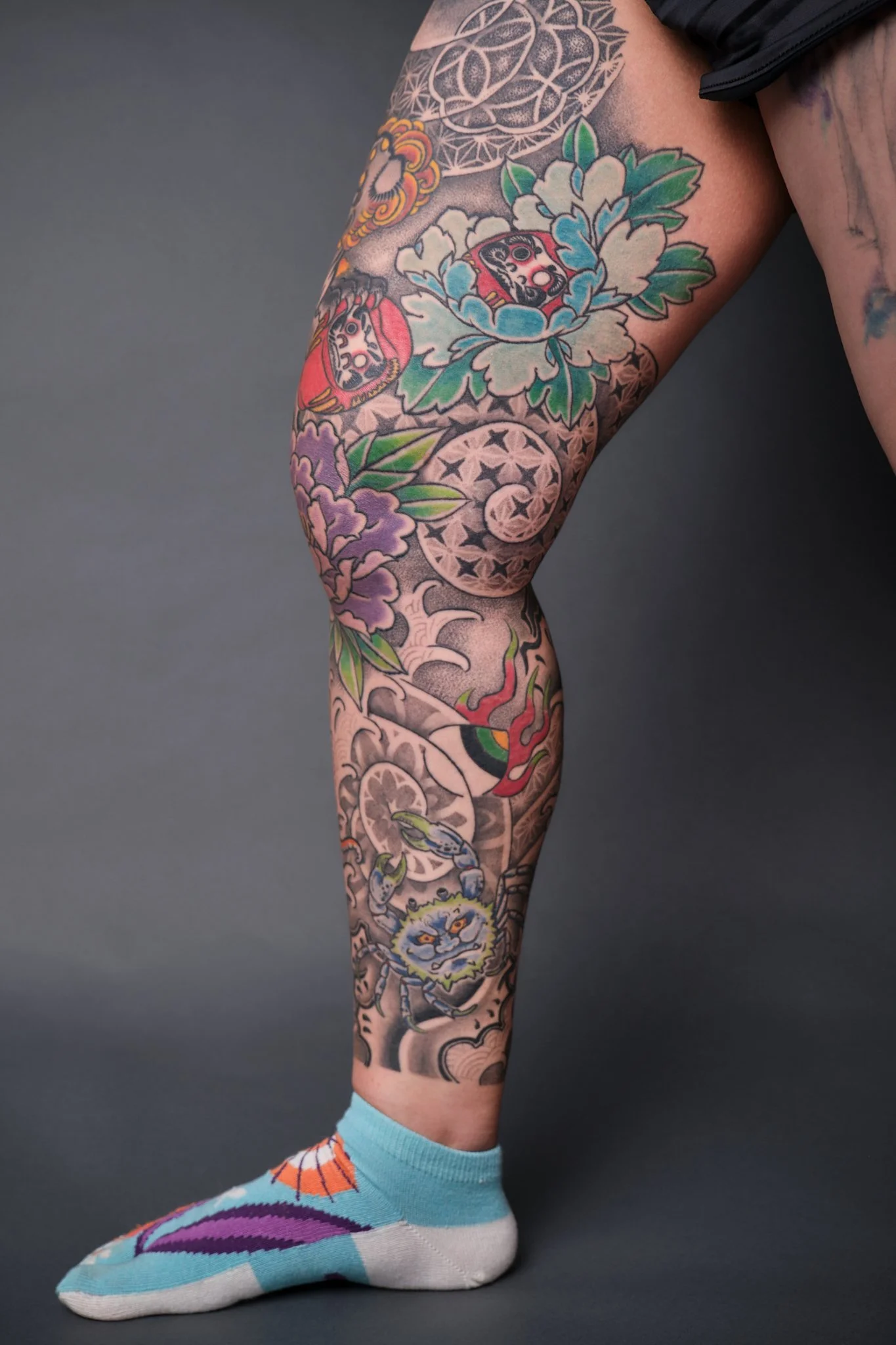
Mixed-style Japanese & stippling geometry leg sleeve
(1-year+ healed photos)


There was existing work by another artist near the top of this leg. Rather than fight it, we integrated it — traditional Japanese blended with stippled geometric pattern in the background so the whole leg reads as one piece.
Fully healed photos, over a year out. If you already have work you don't want removed, this is the conversation to have with me.
Full Japanese leg sleeve
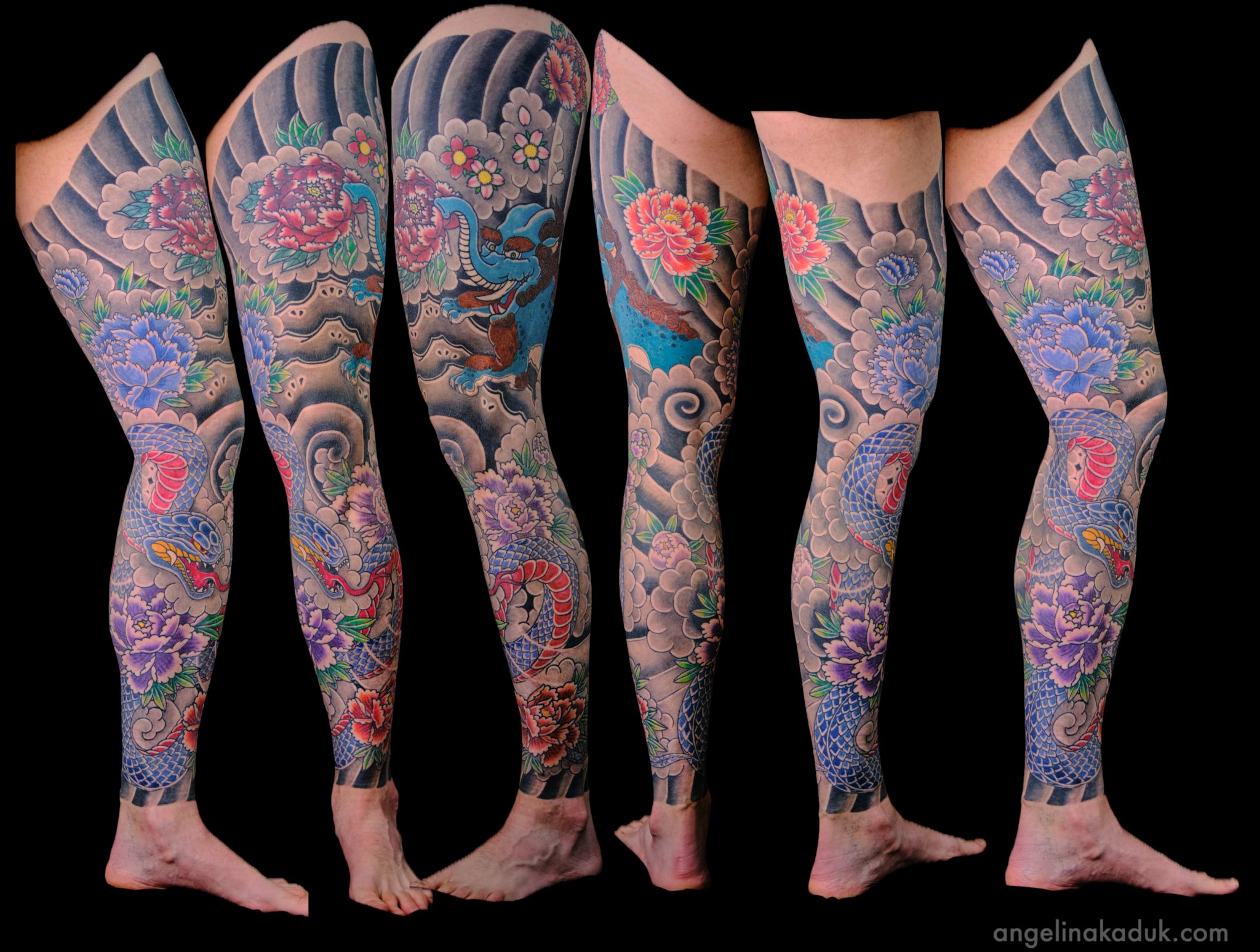
featuring a snake, peony flowers, windbars, and the Baku yokai
This leg sleeve took a looooooong time to create. It started back when I was apprenticing in 2019, and the last coloring was done in December 2023, therefore it took a total of 5 years between the first and the last session to get it done.
The sleeve was worked on in short and rather infrequent sessions at both Bold City Tattoo in Jacksonville FL and Thunderbolt Tattoo in Atlanta GA.
The leg sleeve features some traditional irezumi motives like peony flowers, a snake, a Baku (dream eater) yokai, and traditional windbars in Sumi ink. Peonies are done in red, purple, and blue. The snake has blue scales and red belly, and Baku is done in teal color.


In traditional Irezumi tattoos, the Baku yokai is a cherished symbol of protection and tranquility. This mystical creature, often depicted with the body of a tapir, features an elephant-like trunk, rhinoceros eyes, and an ox's tail, creating an enigmatic and captivating appearance.
The Baku's primary role in Irezumi is to devour nightmares and transform them into positive energy, ensuring peaceful sleep and warding off malevolent forces. This symbolism makes the Baku a popular choice among those seeking both aesthetic beauty and spiritual significance in their tattoos. Typically depicted in dynamic poses, the Baku may be shown in action, with its trunk extended to consume nightmares or its mouth wide open, ready to devour negative energies.
How booking works
Request. Send the form with your idea, placement, and any references. Not knowing exactly what you want yet is fine — most people don't.
Confirm. I'll reply within 24–48 business hours with questions, an estimate, and deposit details.
Schedule. We pick a date. For multi-session projects we book the next one before you leave, so you're never waiting on my availability.
The studio
I work out of a private studio in Toco Hills, ITP Atlanta GA. It's a staffed building with a lot of other independent artists working out of their own suites, so you get the quiet of a private room without being alone in a building with someone you've just met. It is a safe, welcoming, and comfortable space, and I hope you’ll feel like you’re in the right place when you get here!
By appointment only — no walk-ins. Free parking. If you're traveling in from out of state, tell me in your inquiry and we'll build the sessions around your trip.
Also see:
Before you book
-
$250/hour, $100 minimum. A full day is 6 billable hours at $1,500. The real answer depends on size, placement, and how much detail is in the design — send me your idea and I'll give you a range before you commit to anything.
-
Yes. It applies to the total cost, and on multi-session projects it rolls over until your very last session. Deposits are non-refundable and are forfeited on a no-show or a cancellation with less than 48 hours' notice.
-
Usually a few weeks to two months. For a large multi-session project I can work around your availability.
-
Not usually. I draw on the day, though I do prep work in the days beforehand. Small changes on the day are no problem at all — that's normal and expected.
-
It is possible, and it depends — there are two pieces on this page where I did exactly that, integrating another artist's work into a full sleeve so it reads as one design. What I don't do is large cover-ups or reworking someone else's tattoo. If you're not sure which category you're in, send a photo and we’ll figure it out!
-
No, I work with a machine. What I take from the tradition is the composition and the symbolism — how a sleeve is structured, how background carries movement, what the motifs actually mean.
History of Irezumi
-
Irezumi, the traditional Japanese tattoo art, has a rich history that dates back to the Yayoi period (300 BC - 300 AD). Initially, tattoos in Japan were used for spiritual purposes and to mark criminals. By the Edo period (1603-1868), irezumi evolved into a sophisticated art form, often featuring intricate designs of mythical creatures, gods, and nature motifs. These tattoos were popular among the working class, including firemen and manual laborers, as symbols of strength and protection. Irezumi’s distinctive style and cultural significance caught the attention of Westerners in the late 19th and early 20th centuries, leading to its spread globally. Today, irezumi remains highly respected for its artistry and deep cultural roots, influencing contemporary tattoo practices worldwide.
The exchange of irezumi with Western artists began in earnest during the late 19th century when Japan opened its borders to international trade and interaction after the Meiji Restoration. Western sailors, merchants, and travelers visiting Japan were fascinated by the elaborate tattoo work and began getting tattoos from Japanese masters. Prominent irezumi artists like Hori Chyo and Horiuno were known to tattoo foreign clients, which helped spread the art form to the West. This collaborative process involved Western artists learning traditional Japanese methods, such as tebori (hand-poking), and integrating these into their own practices, while Japanese artists adopted some Western tools and equipment, like electric tattoo machines.
Notable American tattoo artists, such as Sailor Jerry (Norman Collins) and Ed Hardy, played significant roles in this cultural exchange. Sailor Jerry, stationed in Hawaii, was heavily influenced by Japanese tattoo art and incorporated its elements into his designs. Ed Hardy, a protégé of Sailor Jerry, studied under renowned Japanese tattoo master Horihide, further blending Eastern and Western tattoo traditions. Modern Japanese tattoo artists like Horiyoshi III continue to inspire and influence global tattoo art with their masterful work.
This interaction is viewed as cultural sharing rather than appropriation due to the mutual respect and acknowledgment of the art form’s origins. Western artists typically honor the traditional aspects of irezumi and often study its cultural and historical significance deeply. They maintain the integrity of the designs and methods, ensuring that the cultural heritage is preserved and celebrated rather than exploited. This respectful exchange has fostered a global appreciation for irezumi, blending artistic traditions while honoring their roots.